


How Do You Store Perfume to Keep It Fresh?
Last Updated: October 24, 2026
Quick Summary
To store perfume so it stays fresh, keep bottles in a cool, dark, dry spot with steady temperatures, such as an interior closet shelf or a dresser drawer away from sunlight. Keep them below 20°C (68°F), sealed tightly with the cap on, and upright in their original boxes. Avoid the bathroom, window sills, kitchens, and the refrigerator, since heat, humidity, light, and temperature swings speed up degradation.
- The bathroom is the worst room for fragrance because hot showers push humidity up and moisture breaks down compounds.
- Most fragrances stay fresh for three to five years, and many sealed bottles hold up much longer in cool, dark conditions.
- Wrap the sprayer nozzle with parafilm on bottles you rarely wear, and keep bottles upright so juice never touches the seal.
- Store samples and decants upright in a labeled box and use them within a year or two, since small vials degrade faster.
- Skip the fridge unless you have a dedicated mini-fridge that stays shut, because door openings cause temperature swings.
Table of Contents
- What You'll Need Before You Store Perfume
- Step 1: Find the Best Place to Store Perfume
- Step 2: Control Temperature and Light Exposure
- Step 3: Seal Bottles and Limit Air Exposure
- Does Perfume Expire? Shelf Life and Degradation Signs
- How Long Does Perfume Last in Storage?
- How to Store Perfume Samples and Decants
- Common Storage Mistakes to Avoid
- Frequently Asked Questions
What You'll Need Before You Store Perfume
Learning how to store perfume to maintain quality starts with a simple truth: heat, light, and air are the three enemies of every bottle you own. At Perfume Outlet, we've been dedicated to providing authentic designer scents since 2006, and our team of experts is committed to helping you discover the perfect fragrance. Most damage we hear about comes from storage, not from the fragrance itself.
Before you move a single bottle, gather a few basics:
- Original boxes for every bottle you still have them for
- A dark, interior closet shelf away from exterior walls
- A small plastic bin with a lid for overflow bottles
- Parafilm or plumber's tape for sealing sprayer nozzles
- A label maker or marker to date each bottle
That's the whole kit. No fancy cabinet required. For a deeper walkthrough of bottle-specific storage, see our guide on storing designer perfume bottles.
Step 1: Find the Best Place to Store Perfume
The best place to store perfume is a cool, dark, dry spot with steady temperatures, such as an interior closet shelf or a dresser drawer away from sunlight. A bedroom closet beats almost every other room in the house because it stays dark and holds temperature well.
Here's how to pick your spot:
- Walk through your home and note which rooms feel coolest and darkest.
- Rule out any spot near a window, radiator, vent, or exterior wall.
- Choose a shelf at eye level so bottles don't get knocked over.
- Keep bottles in their original boxes for extra protection.
Why the Bathroom and Window Sill Fail
The bathroom is the worst room in the house for fragrance. Every hot shower pushes humidity up, and constant moisture breaks down fragrance compounds faster than almost anything else. A window sill is worse: direct sunlight and heat swings attack the juice all day.
Watch out: storing bottles on a sunny bathroom shelf can flatten a scent profile within months, and there's no way to reverse it.
Step 2: Control Temperature and Light Exposure
Keep perfume at a steady room temperature and out of direct sunlight, since UV light and heat both speed up degradation. Small temperature fluctuations matter less than constant swings, so stability is the goal.
A few rules we follow:
- Store bottles below 20°C (68°F) when you can
- Keep them out of direct sunlight and away from UV light
- Avoid rooms that heat up fast, like kitchens and sunrooms
- Never park bottles on top of electronics or near lamps
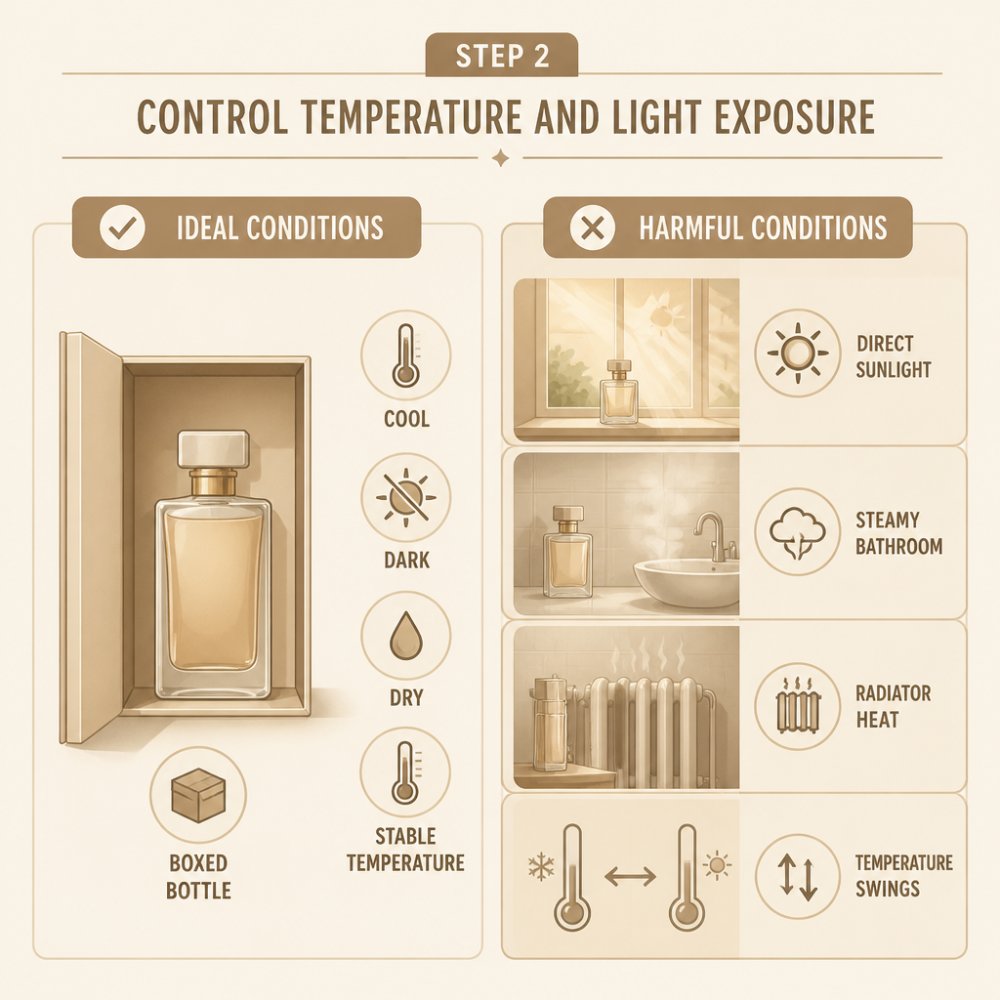
For cologne-specific advice on heat and light, our guide on storing designer cologne properly covers the details.
Should Perfume Go in the Refrigerator?
A refrigerator helps only in specific cases, and it hurts more often than it helps. The cold itself is fine, but every time you open the door, the bottle warms up, then chills again. Those temperature fluctuations are exactly what you want to avoid.
Skip the fridge unless you have a dedicated mini-fridge that stays shut. For everyday bottles, a closet shelf wins.
Step 3: Seal Bottles and Limit Air Exposure
Seal every bottle tightly and keep the cap on, because air exposure and oxidation are what turn a fresh scent stale. Oxygen breaks down fragrance compounds over time, and evaporation quietly steals the top notes.
Our sealing routine:
- Screw the cap on firmly after every use
- Wrap the sprayer nozzle with parafilm on bottles you rarely wear
- Keep the bottle upright so juice never touches the seal
- Store the box closed, not open on a shelf
A common mistake is leaving a cap loose "just for now." That small gap lets air in and scent out.
Does Perfume Expire? Shelf Life and Degradation Signs
Yes, perfume does expire, though most bottles last far longer than the label suggests when stored well. Most fragrances stay fresh for three to five years, and many sealed bottles hold up much longer in cool, dark conditions.
Signs your perfume has degraded:
- The color has darkened or turned cloudy
- The opening smells sharp, sour, or like rubbing alcohol
- The scent fades within minutes of spraying
- A visible layer has separated in the bottle
If you're worried about a favorite bottle, our full guide on storing perfume to preserve scent goes deeper into degradation and rescue.
How Long Does Perfume Last in Storage?
How long perfume lasts depends on three variables: the formula, the concentration, and the packaging. Age alone does not prove a bottle is spoiled, a 15-year-old sealed chypre can smell better than a two-year-old citrus that sat on a windowsill.
Formula. Citrus and aquatic top notes are built on small, volatile molecules that oxidize first, so they fade within a few years even in good storage. Resins, oud, amber, and woody bases are heavier and more stable, often improving with age. Natural absolutes and essential-oil-heavy formulas can darken and shift faster than synthetic-heavy compositions because they contain more reactive compounds.
Concentration. Higher oil concentration generally means slower perceived degradation. An eau de parfum typically outlasts an eau de toilette, and a parfum or extrait outlasts both, not because the alcohol evaporates slower, but because there is more fragrance material relative to the volatile top notes that go first.
Packaging. Glass with a tight crimp or screw seal protects better than splash bottles, rollerballs, and travel sprays, which expose more juice to air per use. Dark or opaque glass slows UV damage; clear glass in a box is fine, clear glass on a shelf is not.
| Fragrance Type | Typical Storage Life | Best Storage Approach |
|---|---|---|
| Citrus / fresh | 2-3 years | Dark drawer, sealed cap, no fridge cycling |
| Floral | 3-5 years | Boxed, closet shelf, upright |
| Woody / amber | 5+ years | Boxed, cool closet, parafilm seal |
| Oud / oriental | 5-10 years | Dark, stable temperature, original box |
| Natural / essential-oil heavy | 2-4 years | Cool and dark; check for darkening |
| Vintage / sealed | 10+ years possible | Stable cool storage; open only when ready |
Degradation signs to check. Darkening or cloudiness, a sharp or sour opening, a scent that fades within minutes, visible separation, or a sticky residue around the neck. One sign alone is not proof, a dark color can be normal for oud and amber. Two or more together usually means the bottle has turned.
If you are deciding whether to keep or retire a bottle, our guide on storing perfume to preserve scent walks through the rescue checklist.
How to Store Perfume Samples and Decants
Store perfume samples and decants upright in a small labeled box, away from light and heat, and use them within a year or two. Small vials have more air contact relative to their volume, so they degrade faster than full bottles.
Our system for samples:
- Group vials by scent family in a divided plastic box
- Label each one with the name and the date you got it
- Keep the box in a drawer, never on a dresser top
- Seal decant sprayers with a strip of parafilm
If you're growing a collection, our guide on building a perfume collection shows how to organize samples alongside full bottles.
Common Storage Mistakes to Avoid
The biggest storage mistake is treating perfume like decor. Bottles displayed on a sunny shelf look great and age badly. Beyond that, here's what we see most often:
- Bathroom storage: humidity and heat wreck fragrance quality fast
- Loose caps: air gets in and evaporation starts
- Laying bottles on their side: leaks and seal damage follow
- Kitchen shelves: cooking heat and steam do real damage
- Ignoring old bottles: a spoiled scent can linger for years unnoticed
Fix these habits and your bottles will smell the way they did on day one. For tips on making each wear last longer, see how to make perfume last longer.
Frequently Asked Questions
Should perfume be stored in the refrigerator?
A refrigerator can work for short-term storage if it stays at a steady cool temperature, but it is not ideal for everyday bottles. Every time you take a bottle out, condensation forms on the glass and the scent warms up, then cools again when you put it back. Those repeated temperature swings do more damage than room temperature ever would. Reserve the refrigerator for backup bottles you rarely touch, and keep daily-use bottles in a cool, dark closet or drawer instead.
Does perfume go bad if it is unopened?
An unopened bottle still degrades, just more slowly. Sealed glass limits oxygen exposure, so the fragrance compounds break down at a slower rate, but heat, light, and humidity still reach the bottle through the packaging. Most unopened designer fragrances hold their scent profile for three to five years when kept cool and dark. If a bottle has sat in a hot garage or a sunny display shelf, expect the top notes to fade first, even if the seal was never broken.
How can you tell if perfume has changed?
The clearest signs are a sharp or sour opening, a color shift toward dark amber, and visible sediment at the bottom of the bottle. Citrus and floral top notes fade first, so a scent that once opened bright may now smell flat or alcohol-heavy for the first few minutes. If the dry-down still matches what you remember, the bottle is usable. If the whole scent profile has turned harsh or vinegary, oxidation has gone too far and it is time to replace it.
Is it better to store perfume in its box?
Yes, keeping the bottle in its original packaging adds a layer of protection against light and small temperature shifts. The perfume box also keeps the bottle upright and cushions it from knocks. If you have tossed the box, a closed drawer or an opaque storage container works nearly as well. Just avoid tight, humid spaces where moisture can collect around the bottle cap and seep into the juice over time.
Most people lose great fragrances to bad storage, not to bad luck. If you want bottles worth protecting, Perfume Outlet has offered authentic designer scents since 2006, with a huge selection of men's and women's fragrances and expert help finding the right match. Shop now and give your next bottle the shelf it deserves.
