


How to Make Perfume Last Longer: 8 Proven Tips
Table of Contents
- Why Your Perfume Fades Faster Than Expected
- Does Moisturizing Skin Help Perfume Last? Yes, Here's Why
- The Best Pulse Points for Perfume Application
- Master the Spray Technique: Distance and Timing
- How to Store Perfume to Make It Last for Years
- A Simple Perfume Concentration Guide for Longevity
- Smart Reapplication and Travel Tips
- Conclusion
- Frequently Asked Questions
Last Updated: September 9, 2026
Why Your Perfume Fades Faster Than Expected
Fragrance longevity is governed by chemistry, not luck. Every perfume is a blend of volatile compounds that evaporate at different rates, and your skin’s surface conditions directly control that evaporation rate. The question of how to make perfume last longer is really a question of managing those variables, from hydration to application technique.
Most people assume a weak scent means a weak formula. In practice, the culprit is often dry skin, which lacks the oils needed to anchor fragrance molecules. When perfume lands on dehydrated skin, the top notes evaporate quickly and the base notes never get a chance to develop. Most people assume a weak scent means a weak formula. In practice, the culprit is often dry skin, which lacks the oils needed to anchor fragrance molecules. When perfume lands on dehydrated skin, the top notes evaporate quickly and the base notes never get a chance to develop.
Below, we’ll show you exactly how to fix this. The eight strategies covered here address the science behind scent so you can get more hours from every bottle, whether you wear a fresh citrus or a heavy oriental.
Does Moisturizing Skin Help Perfume Last? Yes, Here's Why
The short answer is yes, but the mechanism is more specific than 'hydration.' It's about the lipid barrier and the pH of your skin's surface. Your skin's natural acid mantle sits at a pH between 4.5 and 5.5 (peer-reviewed research). Perfume, which is alcohol-based, has a neutral-to-alkaline pH. When you spray directly onto bare skin, the alcohol temporarily disrupts this acidic mantle, causing the fragrance's volatile top notes to evaporate faster and altering how the base notes bind.
Moisturizer acts as a buffer. An unscented, lipid-rich cream or body oil provides a lipophilic (oil-loving) layer that fragrance molecules, which are also lipophilic, dissolve into. This slows the evaporation rate of the alcohol carrier and gives the heavier base notes (like musk and amber) a fatty substrate to anchor to. Without that lipid layer, the scent sits on a dry, slightly acidic protein surface, where it has less to cling to and burns off quickly.
A common pattern is that people with naturally oily skin report longer fragrance wear than those with dry skin. That is not anecdotal; it is because sebum acts as a natural fixative. For those with dry skin, the fix is to mimic that sebum layer with a product. The best choices are body butters containing shea butter or glycerin, or a lightweight squalane oil. Avoid heavy petroleum-based ointments if you are prone to breakouts, as they can trap fragrance against the skin and cause irritation.
For individuals with sensitive skin who cannot tolerate heavy lotions, a fragrance-free, water-based gel moisturizer with ceramides can help repair the skin barrier without adding competing oils. The goal is not to make the skin greasy but to create a stable, slightly acidic film that holds scent molecules at a consistent evaporation rate.
The Best Pulse Points for Perfume Application
The best pulse points for perfume are the warmest areas of your body: wrists, neck, behind the ears, and inside the elbows. These spots emit more heat, which helps diffuse the fragrance and project it outward throughout the day.
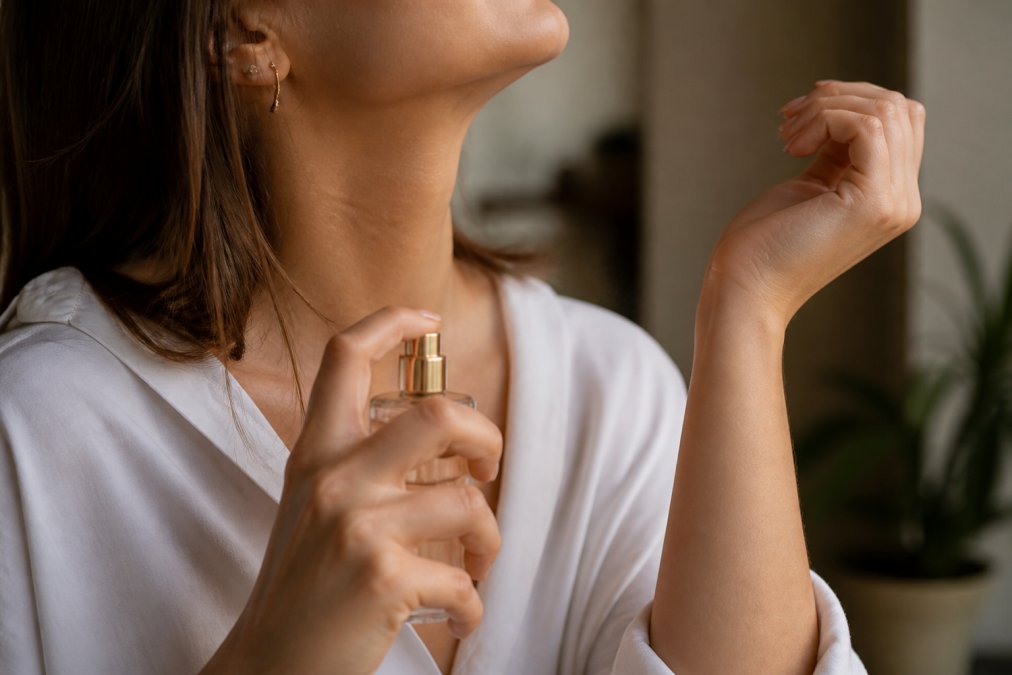
Heat is the key variable. Pulse points sit close to blood vessels, making them consistently warmer than the rest of your body. This warmth activates the fragrance and helps it radiate, which perfumers call sillage. However, more heat does not mean longer wear. High heat speeds up evaporation, so you want warmth for projection but not excessive heat that burns through the scent.
A practical application technique is to spray once on each wrist, once on the neck, and once behind the ears. Do not spray and then immediately get dressed. Let the fragrance dry for a few minutes so the alcohol can evaporate and the scent can bind to your skin.
Master the Spray Technique: Distance and Timing
The distance between the atomizer and your skin changes how the fragrance settles. Hold the bottle about six to eight inches away from your body and spray once. This allows the mist to spread evenly rather than landing in one concentrated spot.
Timing matters just as much as distance. The ideal moment to apply perfume is immediately after a shower, when your pores are open and your skin is clean. Spraying onto damp skin helps lock in the scent, but you should pat yourself dry first. Excess water will dilute the fragrance and weaken its intensity.
Another overlooked factor is where you spray in relation to your clothing. Perfume is designed to interact with your skin’s natural oils and pH levels. Spraying on fabric may make the scent last longer physically, but it will not develop the same way it does on skin, and the oil can stain delicate materials.
How to Store Perfume to Make It Last for Years
Proper storage protects your perfume from the three enemies of fragrance: light, heat, and air. Exposure to direct sunlight and high storage temperatures accelerates oxidation, which breaks down the fragrance molecules and alters the scent over time.
The best place to store perfume is a cool, dark cabinet away from windows and heat sources (the FDA). Bathrooms are a poor choice because humidity and temperature fluctuations degrade the formula. If you want to know how to store perfume to make it last, the answer is consistency: keep the bottle in a stable environment between 60 and 70 degrees Fahrenheit.
Air is the third threat. Every time you open the bottle, oxygen enters and reacts with the fragrance. Once you finish using a bottle, keep the cap tightly sealed. Avoid decanting perfume into smaller containers unless necessary, as this exposes the liquid to more air and increases oxidation risk.
A Simple Perfume Concentration Guide for Longevity
Understanding fragrance concentration helps you choose products that naturally last longer. Concentrations refer to the percentage of perfume oil dissolved in alcohol and water, and this ratio directly determines how long the scent lingers on your skin.
| Concentration | Oil Percentage | Typical Longevity | Best For |
|---|---|---|---|
| Eau de Cologne | 2-4% | 2-3 hours | Quick refresh |
| Eau de Toilette | 5-15% | 3-5 hours | Daytime wear |
| Eau de Parfum | 15-20% | 6-8 hours | Evening and all-day |
| Parfum | 20-30% | 8-12+ hours | Special occasions |
This perfume concentration guide explains why an eau de parfum outperforms an eau de toilette. Higher oil content means more base notes, which are the heaviest and slowest-evaporating molecules in a fragrance. Base notes like amber, musk, and vanilla anchor the scent to your skin, while top notes like citrus and bergamot fade within the first hour.
If you struggle with longevity, moving from an eau de toilette to an eau de parfum is a structural fix that no application trick can replicate. The trade-off is intensity. Eau de parfum sits closer to the skin and projects less aggressively, but it can offer hours of wear.
Smart Reapplication and Travel Tips
Reapplication is not a sign of failure, it is a function of fragrance chemistry. Top notes (citrus, bergamot, light florals) evaporate within 30 to 60 minutes. Heart notes (jasmine, rose, lavender) last 3 to 5 hours. Base notes (sandalwood, vanilla, patchouli) can persist 8 to 12 hours. When you reapply, you are not 'replacing' the scent; you are refreshing the top and heart notes that have already burned off, while the base notes from your first application continue to develop underneath.
Olfactory fatigue is the reason you stop smelling your own perfume. Your nose adapts to continuous stimuli and filters it out, so you think the scent has faded when it is still projecting. Ask a friend or colleague if they can still smell you before you reapply. This prevents over-spraying and keeps your fragrance balanced.
Travel-Friendly Maintenance Without Full Bottles
Carrying a full 100 mL bottle is impractical and risky, pressure changes in airplane cabins can cause leakage, and glass bottles are fragile in checked luggage. Instead, use a refillable atomizer with a metal or glass interior. Plastic atomizers can leach phthalates or absorb the fragrance's essential oils, altering the scent profile over time. Look for atomizers labeled 'airless' or 'vacuum-sealed' to minimize oxygen exposure.
A practical travel routine: before a flight, spray your pulse points and then apply a small amount of unscented balm or lotion on top. This 'sandwiching' technique locks in the fragrance for the duration of the flight. Once you land, do not reapply immediately, your skin's pH and oil production shift with altitude and cabin pressure. Wait 30 minutes, hydrate, and then refresh.
For carry-on compliance with Transportation Security Administration (TSA) regulations, any travel atomizer must be 3.4 ounces (100 mL) or less and fit inside a single quart-sized clear bag (tsa.gov). Most refillable atomizers are 5 to 10 mL, which is well within limits. Keep the atomizer upright in your bag to prevent leakage, and wrap it in a small plastic bag as a secondary precaution.
Conclusion
Making your perfume last longer is a combination of preparation, technique, and product knowledge. Start with hydrated skin, apply to warm pulse points, store your bottles away from light and heat, and choose a concentration that matches your day.
At Perfume Outlet, we help customers find authentic designer fragrances that suit their lifestyle. Since 2006, we have offered a wide selection of men’s, women’s, and unisex scents at outlet prices, with expert guidance to match your style. Explore our collection and find a signature scent you can wear with confidence.
Frequently Asked Questions
Does Vaseline help perfume last longer?
Yes, applying a thin layer of petroleum jelly to your pulse points before spraying creates a barrier that slows the evaporation rate of the fragrance. The ointment holds the scent molecules on your skin longer than bare skin would. This technique works especially well for eau de toilette formulas, which have lower fragrance concentration and tend to fade faster.
Why does my perfume not last on my skin?
Several factors affect scent longevity. Dry skin lacks the natural oils that hold fragrance, causing top notes to evaporate quickly. Your skin's pH levels and body chemistry also interact with fragrance notes differently. Additionally, olfactory fatigue can make you stop smelling your own perfume even when others still can. Try moisturizing your skin before application and spraying at the correct distance to improve performance.
Where is the best place to spray perfume for longevity?
The best pulse points are areas where blood vessels sit close to the skin surface, generating warmth that helps diffuse the scent. Focus on your inner wrists, the sides of your neck, behind your ears, and behind your knees. These warm spots help project the fragrance throughout the day. Avoid rubbing your wrists together after spraying, as this breaks down the fragrance notes and shortens their lifespan.
Get started with Perfume Outlet and discover fragrances built to last. Shop now for guaranteed authentic designer perfumes backed by expert advice.