


How to Store Perfume to Preserve Scent: 2026 Guide
Table of Contents
- The Best Way to Store Perfume: 6 Rules That Protect Scent
- How to Store Perfume Long Term: Backups, Boxes, and Bottle Design
- Does Perfume Expire? Shelf Life and Signs of Deterioration
- Should You Refrigerate Perfume? When Cold Storage Helps and When It Hurts
- Places That Ruin Perfume: Bathrooms, Windowsills, Cars, and Heat
- Storage Troubleshooting for Everyday Use
- Conclusion: Build a Storage Routine That Keeps Every Bottle Fresh
- Frequently Asked Questions
Last Updated: October 13, 2026
The Best Way to Store Perfume: 6 Rules That Protect Scent
Learning how to store perfume to preserve scent comes down to one simple idea: protect the juice from light, heat, air, and moisture. At Perfume Outlet, we have sold authentic designer fragrances since 2006. Storage is not fussy. It just has to be consistent.
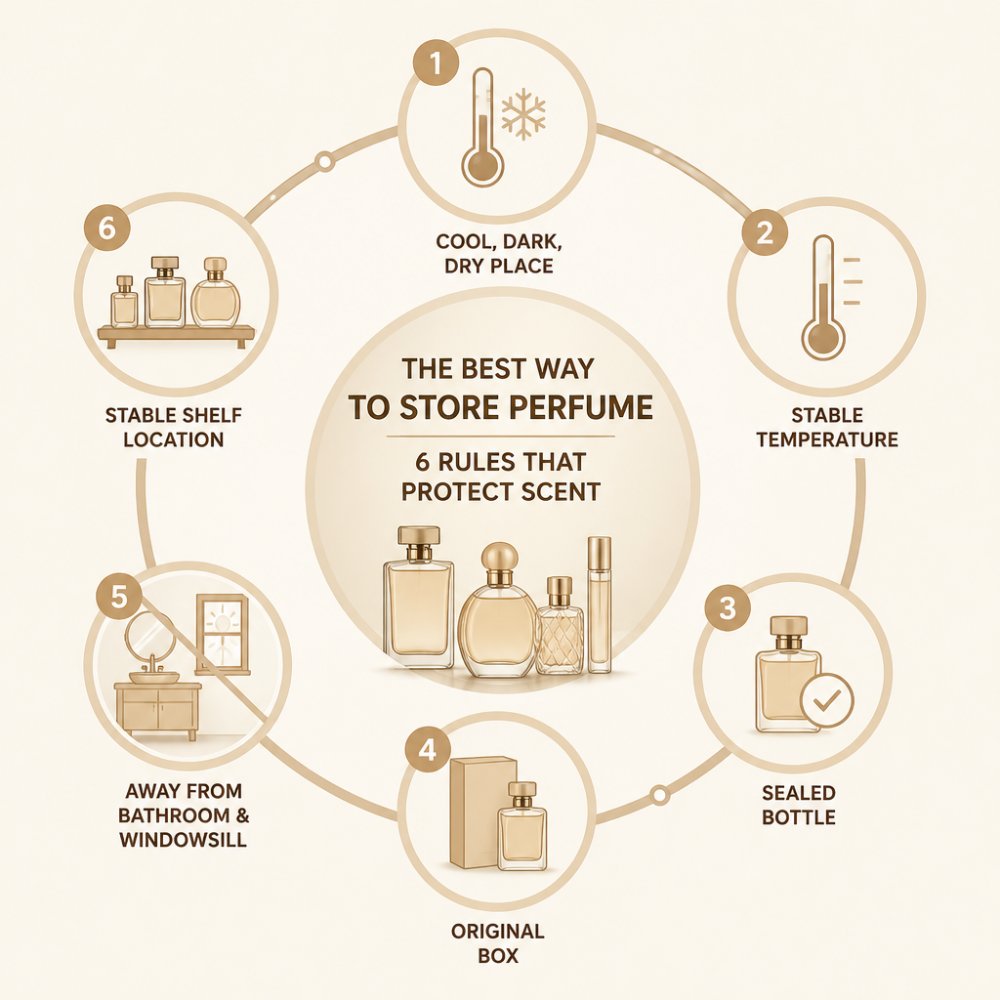
Here are the six rules we give every customer who asks how to keep a fragrance fresh.
- Keep bottles in a cool, dark, dry place
- Hold the temperature steady
- Seal the bottle and limit air exposure
- Store perfume in its original box
- Move it away from bathrooms and windowsills
- Pick one stable shelf and leave it there
Rule 1: Keep Bottles in a Cool, Dark, Dry Place
A cool, dark, dry spot is the single best place for any fragrance. A closed cabinet or drawer away from outside walls works well. Light breaks down the oils that give perfume its smell, so a dark shelf beats a pretty display tray every time.
Rule 2: Control Temperature and Humidity Fluctuations
Steady beats cold. A stable temperature matters more than a chilly one, because repeated swings stress the formula. Humid air also gets into the bottle over time, so keep perfume out of steamy rooms. Aim for a dry, even spot rather than a spot that feels cold in the morning and warm by afternoon.
Rule 3: Seal the Bottle and Limit Air Exposure
Oxygen is the slow killer. Every spray pulls air into the bottle, and that air starts the oxidation that turns a bright scent flat. Keep the cap on tight, close the bottle after each use, and never leave a decant open on a dresser.
How to Store Perfume Long Term: Backups, Boxes, and Bottle Design
Long-term storage is about leaving bottles alone. If you want to know how to store perfume long term, treat backup bottles like archive stock: boxed, sealed, in a stable dark spot, and untouched until you need them. The less you handle a bottle, the longer it lasts.
Storing Unopened and Backup Bottles
An unopened bottle keeps far longer than one in daily rotation. Leave the cellophane and box on, write the purchase month on the box with a marker, and store backups together so you can rotate oldest first. Do not stack heavy bottles on top of each other, since a cracked cap lets air in fast.
Bottle Design and Fragrance Type Matter
Bottle design changes how fast a scent fades. A splash bottle with a wide open neck takes in far more air than a sealed spray bottle. Citrus and light floral scents fade faster than deep oud, amber, or spice blends, so give the lighter ones the darkest, coolest shelf you have.
| Bottle Type | Air Exposure | Best Storage Move |
|---|---|---|
| Spray bottle | Low | Keep in original box, cap tight |
| Splash bottle | High | Decant into a small atomizer |
| Rollerball | Low | Store upright, cap sealed |
| Travel size | Medium | Use first, refill often |
Does Perfume Expire? Shelf Life and Signs of Deterioration
Perfume does expire, but the date depends on how it was stored, not a printed deadline. A well-kept bottle can smell right for years, while one left in a hot car can turn in a single summer. Treat shelf life as a range, not a guarantee.
How to Tell If Perfume Has Gone Bad
Check these signs before you toss a bottle:
- The color has darkened or turned cloudy
- The top notes smell sharp, sour, or like vinegar
- The scent fades within minutes of spraying
- The liquid looks thicker or leaves a sticky film
If the opening smells off but the dry-down still works, the bottle has partly turned. Use it as a room spray rather than on skin.
Should You Refrigerate Perfume? When Cold Storage Helps and When It Hurts
Refrigeration is the most misunderstood storage question, so here is the honest version: cold slows the chemical reactions that degrade a fragrance, but the wrong cold does more harm than a good room-temperature shelf. The deciding factor is not temperature, it is stability and isolation.
When Cold Storage Actually Helps
- Unopened or long-term backup bottles you will not touch for months. A steady cool environment slows oxidation and evaporation, which is exactly what an untouched bottle needs.
- Light, delicate scents, citrus, aquatic, and airy florals, that are more prone to fading than heavy amber, oud, or spice blends.
- A dedicated fragrance cooler or wine-style fridge that holds one steady temperature and is opened rarely. This is the only setup where the benefits clearly outweigh the risks.
When It Hurts
- A shared kitchen refrigerator. Every time the door opens, the interior temperature climbs and drops. That is the exact fluctuation you are trying to avoid, and it is worse than a stable cabinet.
- Any fridge holding food. Fats and strong-smelling foods release volatile compounds that can migrate into a bottle through a worn seal or a splash-bottle stopper. A splash bottle in a fridge next to leftover takeout is a real risk, not a theoretical one.
- Bottles in daily rotation. Pulling a cold bottle out, spraying it, and putting it back creates condensation on the glass and inside the cap every single time. That moisture is the enemy you were trying to avoid.
- Anywhere the bottle cannot stand upright and sealed. A tipped bottle lets liquid pool against the seal, which is how leaks and air intrusion start.
The Condensation Problem
When you take a cold bottle into a warm room, water vapor condenses on the glass and, more importantly, inside the air space of the cap and sprayer. Over many cycles, that moisture can reach the liquid. If you do refrigerate, let the bottle come to room temperature before you open or spray it, and never store it on its side.
Is a Dedicated Cooler Worth It?
For a small collection of everyday bottles, no, a dark interior cabinet at a stable room temperature does the job with none of the downsides. A dedicated cooler starts to make sense when you have unopened backups, discontinued or hard-to-replace scents, or a large collection you rotate slowly. If you go that route, set it to a steady cool temperature, keep bottles upright and boxed, and resist opening it constantly. The cooler only helps if it stays boring.
Places That Ruin Perfume: Bathrooms, Windowsills, Cars, and Heat
A bathroom shelf is the worst spot in most homes. Steam, heat, and constant temperature shifts hit the bottle every time someone showers. A windowsill is next, since direct sunlight and heat work together to break down the formula.
Cars are the fastest way to ruin a fragrance. A bottle left in a hot car can turn in weeks. Keep a travel atomizer in your bag instead of the full bottle in the glovebox. Any spot near a radiator, vent, or stove is also out.
Storage Troubleshooting for Everyday Use
Most storage problems have a quick fix. Match your issue to the solution below.
| Problem | Likely Cause | Fix |
|---|---|---|
| Scent fades fast | Air exposure | Cap tight, decant daily scent |
| Liquid changed color | Light and heat | Move to dark cabinet |
| Bottle smells off | Humidity | Store in a dry room |
| Cap feels loose | Worn seal | Transfer to a new atomizer |
A few habits keep a collection in shape:
- Rotate oldest bottles to the front
- Keep a written note of what you opened and when
- Store backups boxed and sealed
- Check light and heat in your chosen spot twice a year
Conclusion: Build a Storage Routine That Keeps Every Bottle Fresh
A simple routine protects every bottle you own. Pick one dark, dry, steady spot, keep caps tight, and leave backups boxed until you need them. That is the whole system, and it works.
When you are ready to add to your collection, Perfume Outlet has helped fragrance lovers since 2006 with authentic designer scents at outlet prices. Our team offers expert help finding the right scent, and a huge selection of men's, women's, and unisex fragrances, including Arabic fragrances. Get started with Perfume Outlet and build a collection that stays fresh for years.
Frequently Asked Questions
What is the best place to store perfume?
A cool, dark, dry spot with a stable temperature, such as a bedroom closet shelf or dresser drawer away from windows. Avoid bathrooms, windowsills, and cars because heat, humidity, and direct sunlight break down fragrance notes and speed up evaporation. Keeping bottles in their original boxes adds another layer of protection from light exposure.
Does perfume expire, and how long does it last when stored properly?
Perfume does not carry a fixed expiration date, but its scent quality fades over time. An unopened bottle kept in a cool, dark place can stay fresh for several years, while a bottle in daily use typically holds its character for one to three years. Citrus-forward and light fragrances tend to fade faster than heavy oud, amber, or musk blends.
Should perfume be kept in the refrigerator?
Refrigeration can help long-term storage of unopened or backup bottles, but it is not ideal for bottles you use daily. Frequent temperature swings each time you open the door cause condensation and stress the formula. If you do refrigerate, keep the bottle in its original box in the main compartment, never the door, and let it reach room temperature before spraying.
How can you tell if perfume has gone bad?
Watch for a darker or cloudy color, a sharp sour or vinegar-like opening, or a scent that fades within minutes instead of developing through its notes. Shaking the bottle or storing it in heat and light speeds up these changes. If the top notes smell off but the base still performs, the bottle is deteriorating and should be used sooner rather than saved.