


How to Store Designer Perfume Bottles: 2026 Guide
Table of Contents
- Why Proper Storage Protects Your Fragrance Investment
- How to Store Designer Perfume Bottles: Step-by-Step
- Understanding Perfume Shelf Life and Spoilage Signs
- Best Storage Conditions for Fragrance: Temperature, Light, and Humidity
- Perfume Storage Organizers for Display and Preservation
- Common Storage Mistakes That Ruin Fragrance
- Travel Storage Solutions for Perfume Collections
- Frequently Asked Questions
Last Updated: September 18, 2026
Why Proper Storage Protects Your Fragrance Investment
Learning how to store designer perfume bottles correctly is the difference between a scent that smells rich for years and one that turns sharp in months. This guide from Perfume Outlet covers the exact steps, from temperature control to travel cases, so your collection keeps its value.
How to Store Designer Perfume Bottles: Step-by-Step
Storing designer perfume properly takes three steps: keep it boxed, control the climate, and block the light. Each step protects a different part of the formula.
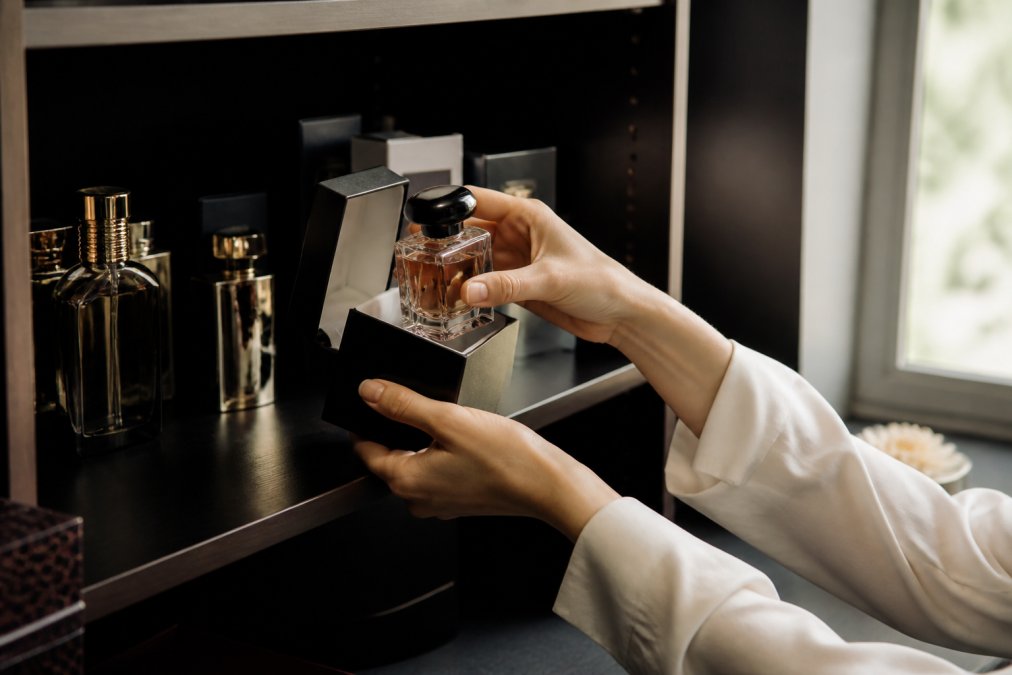
Step 1: Keep Bottles in Original Packaging
The original box is not just marketing. It is a light barrier and a cushion against temperature swings.
Step 2: Control Temperature and Humidity
Aim for a steady ambient temperature between 60 and 70 degrees Fahrenheit. Avoid temperature fluctuations above all.
Step 3: Block UV Exposure and Direct Sunlight
Direct sunlight is the fastest way to break down a fragrance. UV rays attack the chemical composition and speed up oxidation.
Understanding Perfume Shelf Life and Spoilage Signs
Perfume shelf life runs roughly three to five years once opened, and longer if the bottle stays sealed. The exact number depends on the formula and how you store it. But to store well, it helps to understand what is actually happening inside the bottle.
What Actually Breaks Down Inside a Bottle
Fragrance is a fragile chemical system. Three processes drive most spoilage:
- Oxidation. Oxygen reacts with the aromatic compounds in the juice, especially aldehydes and citrus terpenes. The reaction produces new molecules, often sharp, sour, or metallic, that were never part of the original formula. This is why a turned fragrance smells "off" rather than just weak.
- Evaporation. The most volatile molecules, which are usually the bright top notes, escape first every time the bottle is opened. A bottle that gets sprayed daily loses its opening sparkle long before the base notes fade.
- Ester hydrolysis. Many fruity and floral notes are esters, chemical bonds that form when an acid meets an alcohol. Water and heat can break those bonds back apart, which is why a peachy scent can slowly turn soapy or flat.
How the Formula Itself Affects Shelf Life
Not all fragrances age at the same rate. A few general patterns hold:
- Alcohol-heavy eau de toilette and eau de parfum tend to outlast oil-heavy extraits and parfum oils, because alcohol is a more stable carrier than a fatty oil base.
- Citrus-forward scents fade fastest. Bergamot, lemon, and grapefruit top notes are built on volatile terpenes that oxidize quickly.
- Gourmand and woody scents, vanilla, oud, musk, amber, sandalwood, hold up far better because their base molecules are heavier and less reactive.
- Natural absolutes and essential oils can turn faster than synthetic aroma chemicals, because they contain more trace compounds that can react with each other.
Signs a Bottle Has Turned
Watch for these signals, roughly in the order they appear:
- Top notes vanish within minutes of spraying, or smell thin and harsh
- The liquid has darkened, turned cloudy, or developed a visible film
- The scent smells sour, sharp, vinegary, or like nail polish remover
- The color separates or leaves residue on the glass
- It smells nothing like it did when new, even the base notes feel wrong
Can a Turned Bottle Be Fixed?
No. Oxidation and hydrolysis are irreversible chemical changes. Once the molecules have rearranged, no amount of refrigeration, resting, or layering will bring the original scent back. The only real defense is prevention, which is what the storage steps in this guide are designed to do.
Best Storage Conditions for Fragrance: Temperature, Light, and Humidity
The best storage conditions for fragrance come down to three numbers: a steady temperature, low light, and moderate relative humidity.
Here is a quick reference for each factor:
| Factor | Ideal Range | Why It Matters |
|---|---|---|
| Temperature | 60-70°F, steady | Heat speeds up chemical breakdown |
| Light | Near zero, no UV | UV exposure breaks down scent compounds |
| Humidity | 40-60% | High moisture levels damage labels and caps |
| Air exposure | Minimal | Oxygen drives oxidation and evaporation |
The Refrigerator Debate: Helpful or Harmful?
The refrigerator is the most argued-about storage spot, and the answer is: it depends.
Perfume Storage Organizers for Display and Preservation
Most collectors face the same conflict: you want to see your bottles, but every hour on an open shelf is an hour of light and heat exposure. The good news is that you do not have to choose one or the other. You can build a display that preserves.
The Display-vs-Preservation Trade-off, Quantified
Think of light exposure as a budget. A bottle in a closed cabinet spends almost none of it. A bottle on a sunny windowsill can spend a season's worth in a week. The goal is not zero display, it is controlled display.
A practical compromise most collectors land on:
- Keep 80-90% of the collection closed. Boxed, in a drawer, or behind solid cabinet doors.
- Display a rotating handful. Three to five bottles at a time, swapped every few weeks so no single bottle sits in the light long-term.
- Never display near a window, radiator, or vent. Even indirect sun through glass carries UV.
Organizers That Actually Protect
Not all storage looks the same under the lid. Ranked from best preservation to worst:
- A wooden box with a tight lid. Blocks light completely, buffers temperature swings, and looks good on a shelf. Cedar and mahogany are popular because they are dense and stable.
- A drawer insert with dividers. Keeps bottles upright and separated so they do not knock against each other. Pair with a low-drawer location away from heat sources.
- An opaque storage case with a foam or felt interior. The best option for travel and for long-term storage of bottles you rarely wear.
- A cabinet with solid doors. Ideal for a full collection if you have the space. Line the shelves with a soft material to prevent scratches.
- Tinted or UV-filtering acrylic display cases. A middle ground, better than open acrylic, but not as protective as solid wood or opaque cases.
What to Avoid
- Open acrylic stands. They look clean but offer zero UV protection. Use them only in a room with no direct sunlight, and rotate bottles so none sit in a bright spot for long.
- Glass-front cabinets in sunny rooms. The glass filters some UV but not all. If the cabinet faces a window, treat it like an open shelf.
- Clear plastic travel bottles for long-term storage. Plastic is oxygen-permeable over time and can leach into the formula. Fine for a weekend trip, not for a year on a shelf.
Bottle Material Matters Too
The bottle itself is part of the storage system. Clear glass transmits UV. Opaque or colored glass, amber, cobalt, matte black, blocks a meaningful share of it. If you have a choice between two versions of the same fragrance, the darker bottle will age more slowly on a shelf. This is also why decanting into a clear travel atomizer is fine for a trip but a bad idea for long-term storage.
A Simple Rule of Thumb
If you can see the bottle from across the room, it is being displayed. If you have to open something to reach it, it is being preserved. Aim for far more of the second than the first, and your collection will outlast the trend cycle that produced it.
Common Storage Mistakes That Ruin Fragrance
Most ruined bottles come down to a handful of repeated mistakes. Fix these and you protect the whole collection.
- Storing in the bathroom. Steam, heat, and moisture levels swing all day. This is the worst room in the house for perfume.
- Leaving bottles in direct sunlight. A sunny shelf fades a scent fast.
- Decanting into clear, cheap bottles. Plastic and low-grade glass let in light and can react with the formula.
- Keeping the bottle half-empty for years. Air in the bottle drives oxidation.
- Storing near a radiator or vent. Localized heat damage adds up over time.
- Skipping the original packaging. You lose the light barrier and the cushion.
Travel Storage Solutions for Perfume Collections
Travel is where most collections take damage. Pressure changes, heat, and rough handling all work against a bottle.
Pack smart with these steps:
- Decant a small amount into a travel sprayer for the trip.
- Keep the full bottle boxed and upright in your bag.
- Use a padded travel case with individual slots.
- Never pack perfume in a checked bag if you can avoid it.
- Keep the bottle out of heat, like a hot car or a sunny hotel windowsill.
Frequently Asked Questions
Does storing perfume in the refrigerator help it last longer?
A refrigerator can help if it maintains a steady temperature around 50-60°F, but most modern fridges fluctuate with every door opening and cycle. Those temperature swings cause volatile compounds to expand and contract, accelerating fragrance degradation. A cool, dark cabinet away from heat sources is safer. If you do refrigerate, use a dedicated mini-fridge with minimal opening and keep bottles in their original packaging to reduce light and moisture exposure.
How can you tell if a designer perfume has gone bad?
Signs of spoiled perfume include a sharp alcohol smell that overpowers the scent, a darkened or cloudy liquid, and a change in how the fragrance opens. Top notes like citrus and light florals fade first, leaving base notes that smell flat or sour. If the scent profile has shifted noticeably from when you bought it, oxidation has likely altered the chemical composition. Proper storage extends perfume shelf life, but no method reverses damage once it occurs.
Should perfume be kept in its original box?
Yes, storing perfume in its original packaging is one of the simplest ways to protect scent integrity. The box blocks UV exposure, reduces temperature fluctuations, and keeps the bottle away from dust and moisture. If you discard the box for display purposes, place the bottle in a closed drawer or storage cabinet instead. For collectors rotating seasonal scents, keeping boxes labeled and organized makes it easier to find fragrances without exposing them to light.
What is the best room temperature for storing fragrance?
The ideal ambient temperature for fragrance storage is between 55°F and 70°F, away from windows, radiators, and bathroom heat. Relative humidity should stay below 60% to prevent moisture from affecting the cap and seal. A bedroom closet or a dedicated drawer in a cool interior hallway works well. Avoid attics, garages, and cars, where temperature fluctuations and heat damage can degrade a scent within weeks.
A well-kept collection deserves a great bottle to go in it. At Perfume Outlet, we have offered authentic designer scents since 2006, with a huge selection of men's, women's, and unisex fragrances and real expert help finding your next signature. Store your bottles right, then treat yourself to something new. Get started with Perfume Outlet and shop a collection built to last.