


How to Identify Fake Luxury Fragrances: 2026 Guide
Table of Contents
- Start With the Packaging: Cellophane, Seals, and Box Quality
- How to Check Perfume Batch Code and Serial Number
- Signs of Fake Designer Perfume: Bottle, Glass, and Spray Mechanism
- Testing the Liquid: Color, Clarity, Sediment, and Alcohol Content
- Scent Longevity, Dry-Down, and Fragrance Notes: What Fakes Get Wrong
- Gray Market vs. Counterfeit: Why Discounts Are Not Always a Red Flag
- Where to Buy Authentic Designer Cologne and Perfume
- Frequently Asked Questions
Last Updated: September 21, 2026
Start With the Packaging: Cellophane, Seals, and Box Quality
The fastest way to spot fake luxury fragrances is the box in your hands. Genuine luxury houses invest heavily in packaging, and fakes cut corners there first. This guide from Perfume Outlet walks through the checks that matter most.
Counterfeiters copy the bottle shape, then rush the box.
Cellophane Wrapping and Heat-Sealed Edges
Real cellophane is tight, clear, and sealed with a clean, even seam. Fakes use loose, wrinkled, or cloudy film.
Typography, Font Consistency, and Label Alignment
Check every letter on the box. Genuine brands use crisp, consistent typography.
Counterfeit boxes often show:
- Misspelled words or swapped letters
- Fonts that change size between lines
- Labels that sit slightly crooked
- Colors that look faded or oversaturated
A single spelling error is enough to walk away.
How to Check Perfume Batch Code and Serial Number
Learning how to check perfume batch code is the most useful skill in this process. Every authentic bottle carries a batch code on the box and on the bottle itself. Those two codes must match, if they don't, you're almost certainly holding a fake.
Where the Code Actually Lives
Batch codes are small and easy to miss. Check these spots:
- The bottom of the outer box, usually printed in black or stamped in a dot-matrix pattern near the barcode.
- The base of the bottle, etched into the glass, printed on a clear label, or stamped on the underside of the base.
- The back of the bottle, some houses place it near the volume marking (for example, "3.4 FL. OZ.").
- Inside the cellophane seam, a few brands print it on the plastic wrap itself.
What a Batch Code Actually Tells You
A batch code is not a serial number. It identifies the production run, not the individual bottle, so two authentic bottles can share a code, and a unique-looking code proves nothing by itself.
What the code reveals:
- Production date or production window, most houses encode the year and a week or month number.
- Manufacturing plant or line, some brands embed a plant letter.
- Reformulation era, a code from before a known reformulation tells you which formula is inside.
What the code does not reveal:
- Whether the bottle is genuine on its own. A counterfeiter can copy a real code from a real bottle.
- The exact day it was filled. Most brands only encode to the month or week.
Using Interactive Batch Code Verification Tools
This is the step most guides skip. Third-party batch code databases let you type in a code and see the production date the brand assigned to it:
- Photograph the code on the box and the code on the bottle in the same frame so you can compare them side by side.
- Enter the box code into a batch code checker. Note the production date it returns.
- Enter the bottle code. The date must match the box.
- Cross-check the date against the fragrance's launch year. A production date that predates the fragrance's release is impossible, that alone is proof of a fake.
- Cross-check the date against the seller's story. If a seller claims "fresh 2025 stock" and the code returns 2016, walk away.
The Mismatch Patterns That Matter Most
Not every mismatch is equally damning. Rank them like this:
- Box code and bottle code are completely different, near-certain fake.
- Bottle code is missing entirely, very likely fake, unless the brand is known for not coding bottles.
- Code returns a date before the fragrance launched, certain fake.
- Code returns a date after today, certain fake.
- Code returns no result, but box and bottle match, inconclusive; check packaging and scent.
- Code returns a valid date, box and bottle match, good sign, but keep checking.
Why Counterfeiters Get This Wrong
Copying a batch code is easy. Copying a consistent code across the box, the bottle, and a real production date is hard, because the counterfeiter must know which code belongs to which run. Most don't bother, they print one code on the box, another on the bottle, or reuse a code from a different fragrance.
Signs of Fake Designer Perfume: Bottle, Glass, and Spray Mechanism
The bottle tells a story the box cannot hide. Here are the clearest signs of fake designer perfume to check next.
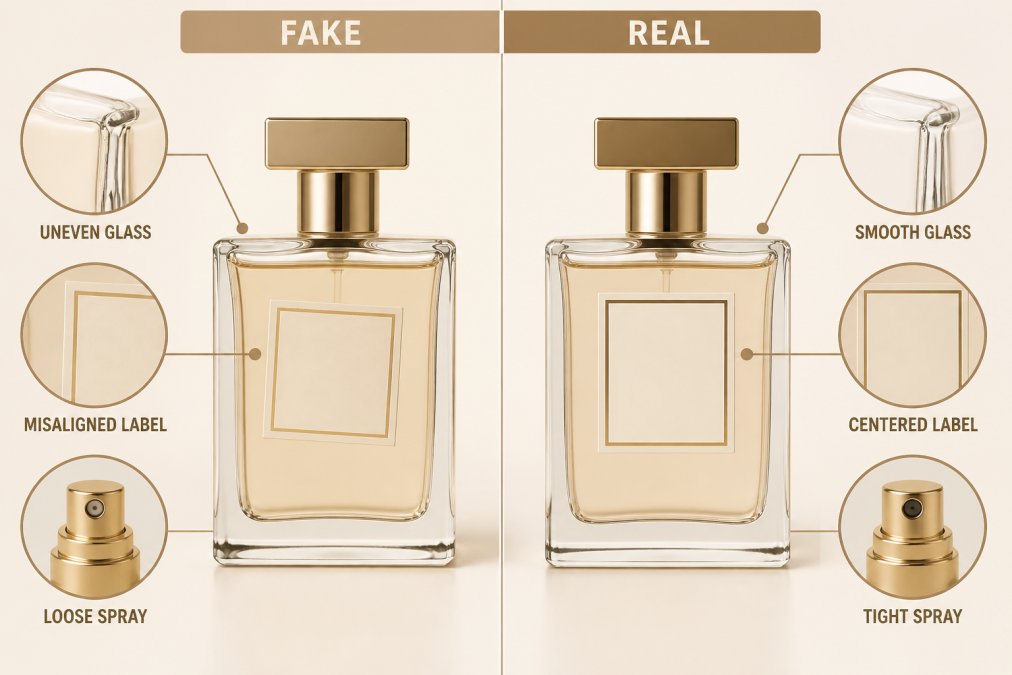
Glass Molding, Embossing, and Bottle Weight
Genuine bottles feel solid: thick, clear glass, free of bubbles or seams.
Counterfeit glass often shows:
- Visible mold lines along the edges
- Wavy or uneven surfaces
- Embossing that looks shallow or smudged
- A bottle that feels oddly light
Inspecting the Atomizer, Dip Tube, and Spray Nozzle
Press the spray mechanism once. A genuine atomizer gives a fine, even mist with light pressure.
Testing the Liquid: Color, Clarity, Sediment, and Alcohol Content
Once the box and bottle pass, the liquid is your next test. Real fragrance is carefully formulated; counterfeits are mixed in unregulated facilities with whatever cheap ingredients are on hand.
The Paper Test
Spray a small amount onto a clean white blotter or printer paper. Let it dry completely, at least 30 minutes.
- Authentic fragrance dries clear or nearly clear, with no visible ring and no oily residue.
- Counterfeit fragrance often leaves a yellow, brown, or oily ring, or a faint stain where the liquid pooled.
Color and Clarity
Hold the bottle against a white background in daylight.
- Authentic: color matches the official product image, and the liquid is transparent. Even dark fragrances are clear, not murky.
- Counterfeit: color runs too dark, too bright, or too yellow. Synthetic dyes are cheap and easy to overdo.
Look for sediment. Real perfume is filtered. Floating particles, cloudiness, or a film on the inside of the glass point to poor manufacturing and contaminated ingredients.
The Alcohol Content Problem
Authentic fragrance uses cosmetic-grade ethanol, typically 60-90% depending on product type (eau de toilette lower, eau de parfum higher, parfum highest). Counterfeiters substitute industrial-grade alcohol, the type used in cleaning products and solvents.
- A sharp, burning, or solvent-like opening that smells like nail polish remover or rubbing alcohol.
- A harsh, stinging sensation on the skin within seconds of spraying.
- A headache or dizziness from a single spray in a small room.
- A scent that evaporates in under 30 minutes because the alcohol flashes off before the fragrance oils can develop.
Chemical Analysis of Counterfeit Ingredients and Health Risks
This is where the real danger starts. Counterfeit perfume is unregulated, no agency reviews what goes inside the bottle before it reaches a seller.
- Diethylene glycol, an industrial solvent chemically related to antifreeze. It's toxic when absorbed through skin and has caused documented poisonings when ingested.
- Methanol, a type of alcohol that is toxic when inhaled or absorbed, and can cause blindness and organ damage at high exposure.
- Banned phthalates, plasticizers used to stretch fragrance oils. Some are restricted in cosmetics because of endocrine-disruption concerns.
- Bacterial contamination, counterfeit production lines are not sterile. Seized samples have tested positive for bacteria that cause skin infections.
- Heavy metals, lead and arsenic have been detected in counterfeit cosmetics, including fragrances, as byproducts of cheap dyes and pigments.
- Urine and animal waste, used as a cheap fixative in some seized counterfeits, particularly in low-end markets.
What to Do If You React
Reaction symptoms usually show up within minutes to a few hours:
- Redness, itching, or a rash at the spray site
- Swelling, especially around the eyes or lips
- Headache, nausea, or dizziness
- Difficulty breathing or tightness in the chest
Why This Section Matters More Than Any Other
Every other check in this guide protects your wallet; this one protects your health. A fake that passes the box test and contains industrial solvent costs you a rash, a headache, or worse. When in doubt, throw it out.
Scent Longevity, Dry-Down, and Fragrance Notes: What Fakes Get Wrong
Real fragrance evolves on your skin: top notes, then heart notes, then base notes hours later.
Gray Market vs. Counterfeit: Why Discounts Are Not Always a Red Flag
A low price does not automatically mean fake luxury fragrances, the distinction most shoppers miss.
| Factor | Gray Market | Counterfeit |
|---|---|---|
| Product | Genuine | Fake |
| Batch code | Valid and matchable | Missing or mismatched |
| Packaging | Original | Copied, often flawed |
| Legal status | Legal | Illegal |
| Price | Discounted | Suspiciously low |
Where to Buy Authentic Designer Cologne and Perfume
The safest path is a seller who verifies authenticity and stands behind it, that's where Perfume Outlet comes in.
Frequently Asked Questions
How can I verify if a perfume is original?
Check the batch code on the box and bottle, then verify it using an online batch code tool. Confirm the cellophane is heat-sealed, the typography is sharp, and the bottle glass has no visible flaws. Compare the scent's dry-down against a known authentic sample. If the price is significantly below retail and the seller is not an authorized distributor, proceed with caution.
Is there an app that can check for fake perfume?
Several batch code verification websites and mobile apps let you enter a code and confirm the production date and origin. These tools work best when cross-referenced with visual inspection. No app can confirm authenticity alone, so use them alongside packaging checks, batch code matching, and scent evaluation for a complete assessment.
How to check the authenticity of a perfume using batch codes?
Find the batch code printed or stamped on the bottom of the bottle and the outer box. They must match exactly. Enter the code into a batch code verification tool to confirm the production date. If the code returns no results, shows a date that predates the fragrance's release, or the box and bottle codes differ, the product is likely counterfeit.
What are the health risks of using counterfeit fragrances?
Counterfeit perfumes often contain unregulated alcohol, synthetic dyes, and unknown chemicals that can cause skin irritation, allergic reactions, or contact dermatitis. Because they bypass safety oversight, the ingredient list may not match what is actually inside. If a fragrance causes burning, redness, or a rash, stop using it immediately and consult a dermatologist.
Counterfeit fragrance is a growing problem, and the health risks are real. The good news is that spotting a fake comes down to a handful of checks you can run in minutes. At Perfume Outlet, we take the guesswork out of buying authentic designer scents. Our guaranteed authenticity, expert scent guidance, and huge selection of men's and women's fragrances mean you shop with confidence. Get started with Perfume Outlet and find a fragrance you will love, backed by a name trusted since 2006.