


How to Find Your Signature Scent: A 2026 Guide
Table of Contents
- Understanding Fragrance Families Explained
- The Science Behind Finding Your Signature Scent
- How to Test Perfume on Skin Properly
- Difference Between Eau de Parfum and Eau de Toilette
- Building Your Fragrance Wardrobe: Seasonal and Mood-Based Selection
- Avoiding Scent Fatigue and Olfactory Reset
- Fragrance Storage and Longevity Tips
- Common Mistakes When Finding Your Signature Scent
- Frequently Asked Questions
Last Updated: September 30, 2026
Understanding Fragrance Families Explained
Fragrance families organize scents by dominant characteristics. By understanding them, you can narrow down your search for your signature scent and avoid options that won't resonate with your preferences.
Main families: floral (rose, peony, jasmine), oriental (warm, vanilla, amber, musk), woody (sandalwood, cedar, vetiver), fresh (citrus, aquatic, green), and aromatic (spice and herbal blends).
Each family has subcategories, fruity florals differ from white florals, soft orientals from gourmand orientals. Start by identifying which family appeals to you emotionally: warmth and comfort, or brightness and energy?
The Science Behind Finding Your Signature Scent
How Skin Chemistry and pH Affect Fragrance
Your skin chemistry fundamentally changes how a fragrance smells on you. pH balance, natural oils, and body temperature create a unique canvas for each scent, which is why testing is essential before committing to your signature scent.
Higher skin acidity makes fragrances last longer and project more strongly. Oily skin holds fragrance longer than dry skin. Warmer skin intensifies scent by accelerating volatile compound evaporation. Pulse points (wrists, inner elbows, neck) are ideal testing locations because they generate heat and show how fragrance develops throughout the day.
Understanding your skin type helps predict fragrance performance. Dry skin may need moisturizing before application to extend longevity; oily skin naturally holds fragrance longer. At Perfume Outlet, our team helps account for these variables when selecting fragrances.
The Fragrance Pyramid: Top, Heart, and Base Notes
The fragrance pyramid describes how a scent evolves over time in three phases. Understanding this structure is crucial for finding your signature scent, because what you smell in the first spray differs from what you'll experience eight hours later.
Top notes are the initial impression, light volatile compounds that evaporate within 5 to 15 minutes. Often citrus, herbal, or fruity, they create the first emotional connection to the scent.
Heart notes (middle notes or accords) emerge as top notes fade, lasting 3 to 5 hours. Often floral, fruity, or spicy, they form the body of the scent and reveal your signature scent's true character.
Base notes are the foundation, lasting 6 to 12 hours or longer. Heavy molecules (woody, musky, vanilla-based) anchor the fragrance and create the lasting impression people remember.
When testing fragrances to find your signature scent, wait through the entire pyramid. Many decide too quickly based on top notes alone, missing heart notes that don't suit them. Waiting 15 to 30 minutes for dry-down gives you the real picture.
How to Test Perfume on Skin Properly
Patch Testing and Waiting for Dry-Down
Testing perfume on skin differs from smelling it in a bottle or on a test strip. Your skin's chemistry and temperature activate fragrance molecules in ways paper cannot replicate. Follow a structured approach to properly test and find your signature scent.
Start with a patch test on your inner wrist or elbow. Apply a single spray and resist sniffing immediately. Your olfactory system adapts quickly to scents (olfactory adaptation). Waiting allows your nose to experience the fragrance as it truly develops rather than through fresh application intensity.
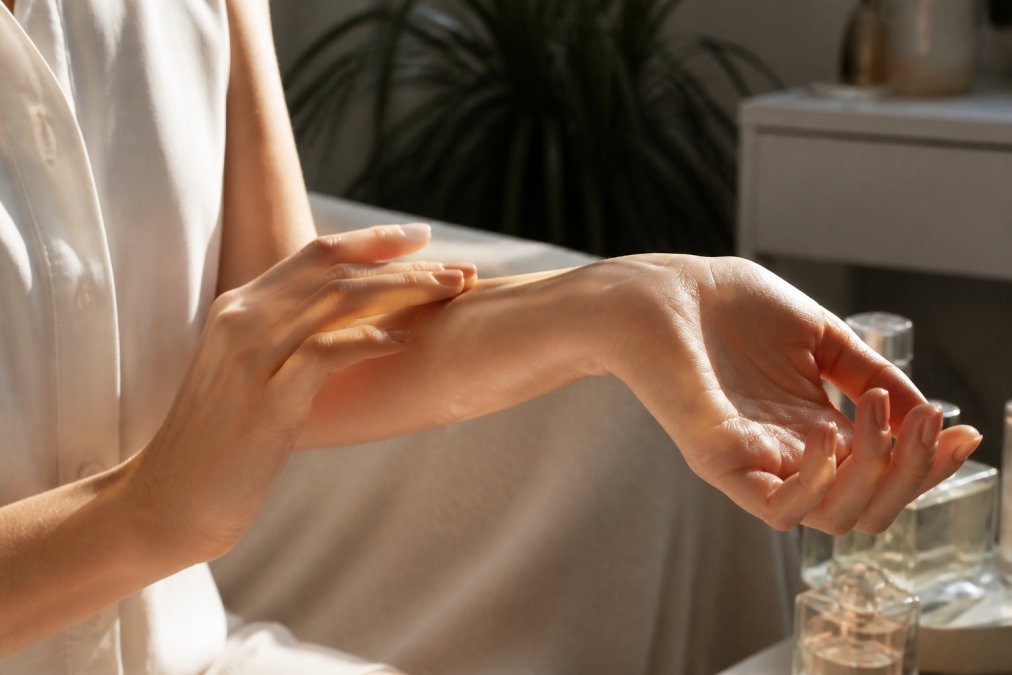
The dry-down process takes 15 to 30 minutes as top notes fade, heart notes emerge, and base notes anchor. Keep a fragrance journal noting the name, application time, and impressions at 5-minute intervals. This data becomes invaluable when narrowing down options to find your signature scent.
Limit yourself to two or three fragrances per visit, spaced on different pulse points. This prevents olfactory confusion and gives each fragrance room to develop.
Understanding Sillage and Projection
Sillage is the scent trail a fragrance leaves behind. Projection is how strongly it smells when you're close to it. Both are influenced by fragrance concentration, skin chemistry, and environmental factors like humidity and temperature.
Eau de parfum typically has stronger sillage and projection due to higher fragrance concentration, but skin chemistry matters more than concentration level. When finding your signature scent, consider where you'll wear it: strong projection suits evening events but may overwhelm an office.
Test sillage by stepping back after application. Can you smell it at arm's length? Two feet away? Have someone else report. This gives objective data about real-world performance.
Difference Between Eau de Parfum and Eau de Toilette
Eau de parfum contains 15-20% fragrance concentration and lasts 4 to 8 hours. Eau de toilette contains 5-15% concentration and lasts 2 to 4 hours.
Eau de parfum is more expensive but requires fewer applications.
Building Your Fragrance Wardrobe: Seasonal and Mood-Based Selection
Scent Layering Techniques for Personalization
Scent layering combines multiple fragrances to create a personalized experience. Start with a base fragrance (your core signature scent) and layer complementary scents on top to customize for mood, occasion, or season.
Budget-Conscious Signature Scent Building
Building a signature scent collection doesn't require spending a fortune. Start by identifying one core fragrance that resonates with you across multiple wearings. This becomes your anchor, the scent you return to repeatedly. Once you've committed to your signature scent, explore complementary fragrances within the same family or with similar heart notes.
Avoiding Scent Fatigue and Olfactory Reset
Scent fatigue (or olfactory adaptation) occurs when your nose stops detecting a fragrance you wear regularly. This happens because your olfactory receptors become desensitized to constant exposure. The fragrance hasn't changed, your perception of it has.
Fragrance Storage and Longevity Tips
How you store fragrances directly impacts their longevity and quality. Fragrances are sensitive to light, heat, and air exposure. Store your bottles in a cool, dark place, ideally between 50-70°F. Direct sunlight degrades fragrance molecules and alters the scent profile over time. A closed cabinet or drawer works better than a bathroom counter or windowsill.
Common Mistakes When Finding Your Signature Scent
The most common mistake is deciding too quickly based on top notes alone. Top notes fade within minutes, and judging a fragrance before experiencing the heart and base notes leads to poor choices. Give every fragrance at least 15 to 30 minutes of wear before deciding.
Frequently Asked Questions
What is the 3:1:1 rule for perfume?
The 3:1:1 rule is a guideline for building a balanced fragrance wardrobe: 3 fragrances for everyday wear, 1 for special occasions, and 1 for seasonal rotation. This approach helps you discover your signature scent without overwhelming yourself with too many options at once. It's a practical framework for collectors and beginners alike to test different scent profiles and identify which fragrances truly resonate with your personality and lifestyle.
How does skin chemistry affect which fragrance will be my signature scent?
Your skin's pH balance, natural oils, and body chemistry significantly alter how a fragrance develops on you. The same eau de parfum may smell different on two people because of variations in skin temperature, moisture levels, and hormonal factors. Testing fragrances on your own skin for at least 4-6 hours during the dry-down phase reveals how your unique chemistry interacts with the scent's top, heart, and base notes. This is why trying before buying is essential when finding your signature scent.
What's the difference between eau de parfum and eau de toilette in terms of longevity?
Eau de parfum contains 15-20% fragrance concentration and typically lasts 4-6 hours or longer, while eau de toilette has 5-15% concentration and lasts 2-4 hours. If longevity is important for your signature scent, eau de parfum offers better value despite higher upfront costs. However, eau de toilette works well for layering, testing new scents, or wearing in warm weather. Consider your lifestyle and how long you need your fragrance to project throughout the day.
How can I avoid olfactory fatigue when testing multiple fragrances?
Olfactory fatigue occurs when your nose becomes desensitized to a scent after continuous exposure. To reset, step outside for fresh air, smell coffee grounds or your own skin, or wait 15-20 minutes between testing different fragrances. Limit yourself to testing 3-4 scents in one session rather than trying everything at once. This approach helps you accurately assess each fragrance's true scent profile and prevents decision fatigue when discovering your signature scent.
Should I choose a signature scent based on my personality or the season?
The best approach combines both. Your personality guides your overall scent preferences, while seasonality determines which fragrances from your collection you wear. Warm, spicy fragrances work better in fall and winter, while fresh, citrus-based scents suit spring and summer. Many fragrance enthusiasts maintain multiple signature scents, one for each season or mood. This strategy lets you enjoy different fragrance families throughout the year while staying true to your personal style.
How long should I wait before deciding if a fragrance is truly my signature scent?
Wear a fragrance for at least 3-5 days before making a final decision. A single test reveals the initial impression, but living with a scent shows whether it suits your daily routine, complements your natural body chemistry, and remains appealing after the novelty wears off. Pay attention to how the fragrance performs during the dry-down phase, how long it lasts on your skin, and whether you find yourself reaching for it repeatedly. True signature scents are ones you genuinely want to wear, not ones that impress you once.