

How to Choose Perfume Without Smelling It: 2026 Guide
Table of Contents
- How to Read Perfume Notes Before You Buy
- Fragrance Families Explained: Match Scents to Your Style
- The Difference Between EDT and EDP: Concentration Matters
- How Skin Chemistry Changes What You Smell
- Using Reviews, Ratings, and Discovery Sets to Choose Perfume
- Layering and Return Policies: Smart Blind Buy Strategies
- Conclusion: Build Confidence in Every Blind Buy
- Frequently Asked Questions
Last Updated: September 16, 2026
How to Read Perfume Notes Before You Buy
Learning how to choose perfume without smelling starts with decoding the notes listed on every product page. Perfume notes are the individual scent components that unfold over time, and reading them in sequence tells you what a fragrance will actually smell like on your skin. This guide from Perfume Outlet breaks down a framework for matching customers with scents they may love, sight unseen.
Most buyers skim past the note list and jump straight to the star rating.
The Olfactory Pyramid: Top, Heart, and Base Notes
The olfactory pyramid is the three-tier structure that describes how a fragrance evolves from first spray to dry down. Top notes hit immediately and last 15 to 30 minutes. Heart notes emerge next and carry the fragrance's main character for a few hours. Base notes anchor everything and can linger for six hours or more.
Reading a Fragrance Description Like a Pro
A fragrance description is the written summary of a scent's notes, family, and mood, and it follows a predictable structure once you know the pattern. Look for the note sequence, the concentration (covered below), and any mood words like "fresh," "warm," or "sensual." Those mood words are marketing, but the note list is not.
Fragrance Families Explained: Match Scents to Your Style
Fragrance families are broad categories that group scents by their dominant character: floral, oriental (also called amber), woody, fresh, and gourmand. Knowing your family narrows hundreds of options to a manageable shortlist before you read a single review.
The Main Fragrance Families and What They Smell Like
- Floral: rose, jasmine, peony. Romantic and traditionally feminine.
- Oriental/Amber: vanilla, amber, spices. Warm, rich, and long-lasting.
- Woody: cedar, sandalwood, vetiver. Grounded and unisex.
- Fresh: citrus, aquatic, green notes. Light and office-friendly.
- Gourmand: caramel, coffee, chocolate. Sweet and edible-smelling.
Using the Fragrance Wheel to Narrow Your Choices
The fragrance wheel is a circular chart that maps how scent families relate to one another, and it is the fastest way to find adjacent options when you know one fragrance you like. If you love a woody scent, the wheel points you toward oriental and fresh-woody hybrids nearby. Most brand websites publish a wheel or family tag on each product page.
Fragrance Foundation's guide to fragrance families
The Difference Between EDT and EDP: Concentration Matters
The difference between EDT and EDP comes down to fragrance oil concentration, and it directly affects how long a scent lasts and how far it projects. Eau de toilette (EDT) typically contains a lower concentration of aromatic compounds, while eau de parfum (EDP) contains more. Higher concentration generally means longer longevity and stronger sillage.
What the Concentration Label Actually Tells You
The label on the bottle is a rough range, not a fixed recipe. A common industry pattern is:
- Eau de cologne: roughly 2-5% aromatic compounds
- Eau de toilette (EDT): roughly 5-15%
- Eau de parfum (EDP): roughly 15-20%
- Parfum / extrait: roughly 20-30%
How Concentration Affects Longevity and Sillage
Longevity is how long a fragrance lasts on your skin. Sillage is the trail it leaves behind you. An EDT might last four to five hours with moderate sillage; an EDP often runs six to eight hours with a heavier trail. For a first blind buy, an EDT is the safer bet because a lighter scent is harder to over-apply and easier to layer.
| Concentration | Typical Longevity | Sillage | Best For |
|---|---|---|---|
| Eau de cologne | 2-3 hours | Light | Quick refresh, hot climates |
| Eau de toilette (EDT) | 4-5 hours | Moderate | Office, daytime, first blind buys |
| Eau de parfum (EDP) | 6-8 hours | Strong | Evening, cold weather, signature scents |
| Parfum / extrait | 8+ hours | Heavy | Special occasions, cold weather |
The Blind-Buy Trade-Off Nobody Mentions
Higher concentration is not automatically better for a blind buy. A parfum or heavy EDP amplifies every note, including the ones you might dislike. If a fragrance's base notes are the risk, a stronger concentration makes that risk louder, not safer. A lighter EDT gives you a smaller commitment and lets you test whether the dry down works before you invest in the full-strength version.
International Fragrance Association on fragrance ingredients
How Skin Chemistry Changes What You Smell
Skin chemistry is the way your body's natural oils, pH, and temperature interact with a fragrance to change how it smells on you versus on paper. The same perfume can read sweet on one person and sharp on another. This is why a fragrance that smells incredible on a friend can fall flat on you.
The Mechanism: Why Your Skin Rewrites a Scent
Fragrance molecules evaporate at different rates depending on what they sit on. Your skin's surface is slightly acidic, typically in the pH 4.5-5.5 range, and that acidity interacts with the aroma compounds in a fragrance. Some molecules break down faster in an acidic environment; others cling longer. Sebum (your skin's natural oil) acts as a fixative, oilier skin tends to hold base notes longer and can amplify heavy, resinous scents, while drier skin releases top notes quickly and lets the fragrance fade sooner.
The Variables You Can Actually Control
You cannot change your pH, but you can change how a fragrance performs on you:
- Hydration: Moisturized skin holds fragrance longer. Dry, flaky skin sheds scent fast. Applying an unscented lotion or a matching body cream before spraying gives the molecules something to bind to.
- Application point: Pulse points (wrists, neck, behind the ears) are warmer and project more. Spraying on clothing or hair extends longevity but changes the dry down because fabric does not have skin chemistry.
- Diet and medication: Some people notice that spicy food, garlic, or certain medications shift how a fragrance reads on them. The effect is real but hard to predict, so treat it as a variable, not a rule.
- Layering with a base: A matching body lotion or an unscented barrier cream can stabilize a fragrance that fades too fast on you.
What This Means for a Blind Buy
Reviews describe how a fragrance performed on someone else's skin. Treat them as a range, not a guarantee. When you read a review, look for the reviewer's stated skin type and climate, a dry-skinned reviewer in a cold climate reporting weak longevity is telling you something different than an oily-skinned reviewer in a humid one reporting the same thing. If most reviewers with your skin profile report the same behavior, that is the closest thing to a prediction you can get without spraying it yourself.
Using Reviews, Ratings, and Discovery Sets to Choose Perfume
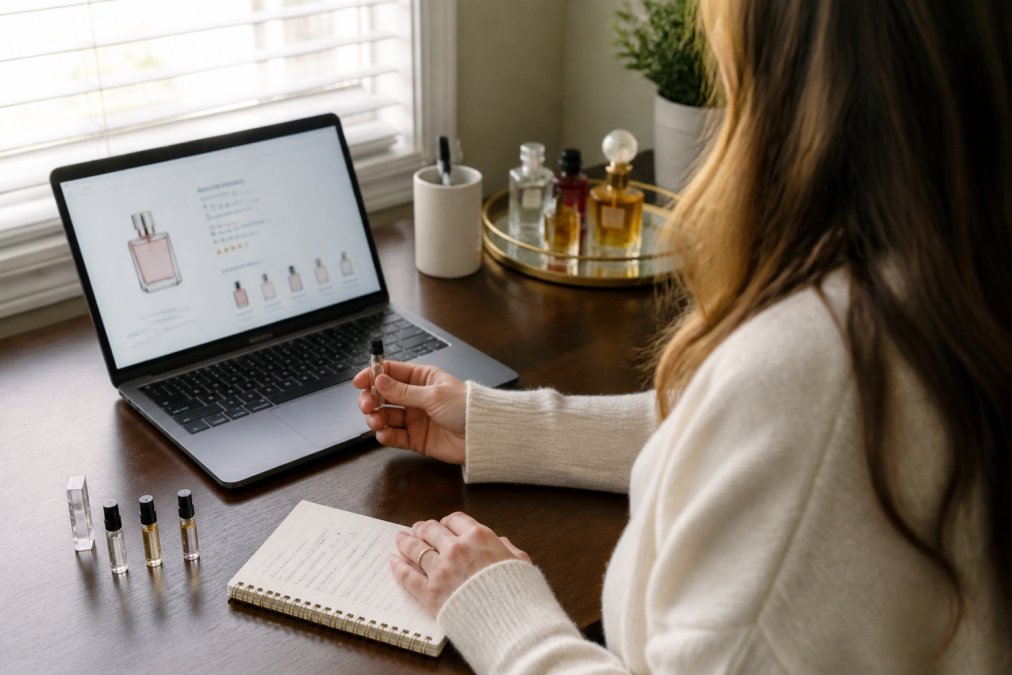
Customer reviews and discovery sets are the two most reliable tools for choosing perfume without smelling it first. A discovery set is a curated collection of small sample vials that lets you test several fragrances on your own skin before committing to a full bottle. It removes most of the guesswork from a blind buy.
Layering and Return Policies: Smart Blind Buy Strategies
Fragrance layering is the practice of combining two or more scents to create a custom profile, and it is one of the best safety nets for a blind buy that misses the mark. If a fragrance is too sweet, layer it with a woody or citrus scent to balance it out. If it is too weak, layer it over a matching base note to boost longevity.
Conclusion: Build Confidence in Every Blind Buy
Choosing perfume without smelling it is a skill, not a gamble, and it comes down to reading notes, knowing your family, and testing before you commit. The challenge is finding a retailer that stocks authentic designer scents and gives you real guidance instead of a self-serve catalog.
Frequently Asked Questions
What is the difference between EDT and EDP when buying perfume online?
EDT (eau de toilette) typically contains 5-15% fragrance oil, while EDP (eau de parfum) contains 15-20%. EDP generally lasts longer and projects more, making it a safer blind buy if you want a scent that stays with you through a workday. EDT is lighter and often better for warm weather or office settings. When reading descriptions online, check the concentration label carefully because the same fragrance name can come in both versions with noticeably different performance.
How does skin chemistry affect how a perfume smells on me?
Your skin's pH, oil levels, and temperature all influence how a fragrance develops after application. A perfume that smells great on a friend may pull differently on you because the top notes evaporate at different rates. This is why reading reviews from people with similar skin types helps. If you tend to have dry skin, fragrance fades faster, so EDP concentrations or layering with an unscented moisturizer can extend wear time.
Are online perfume reviews reliable for choosing a new scent?
Reviews are useful when you read them strategically. Look for reviewers who describe specific notes, longevity, and sillage rather than just saying a perfume is good or bad. Pay attention to whether the reviewer's preferences align with yours. A fragrance with hundreds of reviews mentioning similar notes and performance is a safer bet than one with few reviews. Cross-reference multiple sources, including fragrance community sites and retailer reviews, before committing to a full bottle.
What should I look for in a perfume description to ensure I like it?
Start with the note breakdown: top notes hit first, heart notes emerge after 15-30 minutes, and base notes define the dry down. If you already know you enjoy vanilla, amber, or musk base notes, look for fragrances that feature them prominently. Check the concentration (EDP vs EDT), read the accord list, and note whether reviewers mention it leans masculine, feminine, or unisex. Matching the description to scents you already own reduces the risk of a disappointing blind buy.