


EDT vs EDP: The Real Difference, Explained
Table of Contents
- EDT vs EDP: What the Labels Really Mean
- EDT vs EDP: A Side-by-Side Comparison
- Does EDP Last Longer Than EDT? Longevity and Sillage
- How to Apply Perfume for Better Projection
- The Best Perfume Concentrations for Summer
- Why Skin Chemistry and Climate Change the Answer
- EDP vs EDT: Which One Should You Buy?
- Frequently Asked Questions
Last Updated: September 7, 2026
EDT vs EDP: What the Labels Really Mean
The difference between edt and edp comes down to one core factor: the concentration of fragrance oils in the bottle. Eau de Toilette (EDT) typically contains 5-15% perfume oil, while Eau de Parfum (EDP) holds a higher 15-20% concentration (ifrafragrance.org). That single number changes everything about how a scent performs, how long it lingers, and what occasions it suits.
At Perfume Outlet, our team has guided thousands of customers through this exact choice since 2006. Understanding the edt vs edp distinction is the first step toward building a fragrance wardrobe that actually works for your lifestyle. The labels aren't marketing fluff; they are precise indicators of how the fragrance pyramid will unfold on your skin. Top notes, heart notes, and base notes each evaporate at different rates, and the oil concentration dictates how long each stage lasts.
Fragrance Concentration Levels Explained
Fragrance concentration is the percentage of perfume oil dissolved in alcohol and water. Higher oil content means fewer volatile compounds evaporating quickly, which slows the scent's release and extends its lifecycle. EDT sits at the lighter end with 5-15% oil, EDP occupies the middle ground at 15-20%, and pure parfum exceeds 20% for the most intense experience.
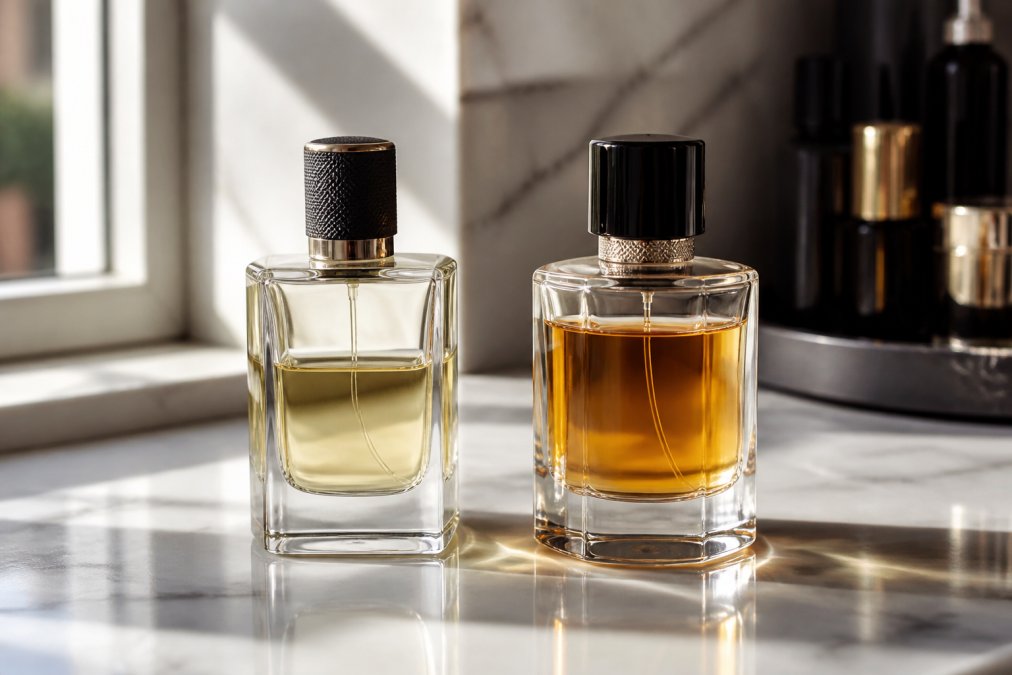
EDT vs EDP: A Side-by-Side Comparison
The practical difference between edt and edp reveals itself across four dimensions: longevity, projection, alcohol content, and price. EDT contains more alcohol, which makes it evaporate faster and project boldly in the first hour before settling close to the skin. EDP's higher oil ratio produces a more intimate diffusion that unfolds gradually over several hours.
| Factor | EDT (Eau de Toilette) | EDP (Eau de Parfum) |
|---|---|---|
| Oil concentration | 5-15% | 15-20% |
| Typical longevity | 3-5 hours | 6-8 hours |
| Projection | Bold, quick burst | Intimate, steady |
| Alcohol content | Higher | Lower |
| Price point | More budget-friendly | Costs more |
| Best for | Daytime, office, warm weather | Evening, cooler months, special occasions |
Consider Dior Sauvage as a real-world example. The EDT version delivers that signature citrusy, woody burst ideal for casual daytime wear, while the EDP offers a richer, deeper profile with noticeably longer staying power. Both are excellent; they simply serve different moments.
Does EDP Last Longer Than EDT? Longevity and Sillage
Yes, EDP lasts longer than EDT because the higher concentration of essential oils slows evaporation. The fragrance pyramid unfolds more deliberately: top notes fade within the first hour, heart notes carry the middle of the day, and base notes anchor the scent for hours afterward. EDP's staying power typically reaches 6-8 hours on skin, while EDT fades closer to 3-5 hours.
Sillage, the trail a fragrance leaves behind, also shifts with concentration. EDT projects loudly at first but dissipates quickly, making it ideal for close quarters. EDP sits closer to the body, creating a more personal scent bubble that those nearby will notice without feeling overwhelmed.
How to Apply Perfume for Better Projection
Most guides tell you to spray on pulse points and move on, but the difference between edt and edp should change your entire application strategy. The two concentrations behave differently on skin, so treating them the same way leaves performance on the table.
Why EDT Needs Distance and EDP Needs Contact
EDT's higher alcohol content means it evaporates quickly, carrying scent molecules upward in a fast, wide burst. Spraying from 6-8 inches away lets that alcohol disperse evenly, preventing a harsh, concentrated blast that can overwhelm the first hour. EDP, with its denser oil load, benefits from a closer spray at 3-4 inches. The heavier molecules need direct contact with skin to warm up and release gradually. A common pattern among fragrance enthusiasts is that EDP sprayed too far away simply hangs in the air and dissipates before binding to skin.
The Pulse Point Myth, Refined
Pulse points work because they radiate heat, but not all pulse points perform equally. The inside of your wrists and the sides of your neck are the most effective for both concentrations. Behind the knees and inside elbows work but are often covered by clothing, which traps the scent and changes how it projects. For EDT, stick to exposed pulse points to let the lighter composition breathe. For EDP, you can afford to spray on covered pulse points because the slower evaporation means the scent will still radiate through fabric over time.
The Rubbing Wrists Debate, Settled
Rubbing wrists together is universally discouraged, but the reason matters more for one concentration than the other. EDT's top notes are already volatile; friction generates heat that accelerates their evaporation, cutting the opening phase short. EDP's top notes are more stable, so rubbing does less damage, but it still smears the fragrance across a larger surface area, thinning the scent bubble. The better habit for both: spray, let dry for 30 seconds, and walk away. If you need to contain the scent, apply a single spray to your chest under your shirt instead of layering multiple sprays on exposed skin.
Concentration-Specific Spray Counts
A standard rule of thumb is 3-4 sprays total, but that assumes average conditions. For EDT, 4-6 sprays is often necessary to achieve comparable presence to EDP, especially if you're heading into air conditioning or moving between temperature zones. For EDP, 2-3 sprays is usually sufficient; more than that and the heavier oils can become cloying in enclosed spaces. The right number also depends on your clothing, fabrics like cotton and wool absorb fragrance, so a spray on your collar or scarf acts as a reservoir that re-emits scent throughout the day.
The Best Perfume Concentrations for Summer
For summer wear, EDT is frequently the better choice. Heat amplifies fragrance intensity, and the lighter composition of EDT prevents the scent from becoming cloying in high temperatures. The brisk citrus and aquatic notes common in EDTs pair naturally with warm weather and casual settings.
EDP shines in cooler months when its heavier base notes need warmth to develop fully. The same fragrance can smell entirely different across seasons: an EDP that feels suffocating in July becomes rich and inviting in December. Many collectors rotate between concentrations seasonally, keeping both an EDT and EDP version of their signature scent.
Why Skin Chemistry and Climate Change the Answer
The edt vs edp decision isn't purely mathematical. Two people can spray the same bottle and get radically different results because skin chemistry and environment alter how fragrance molecules behave. Understanding the mechanisms helps you predict performance before you buy.
How Skin Type Rewrites the Rules
Oily skin holds fragrance longer because sebum, the skin's natural oil, binds with hydrophobic fragrance compounds, slowing their evaporation. If you have oily skin, an EDT may perform closer to an EDP's expected longevity, often reaching 5-6 hours instead of the typical 3-5. Dry skin lacks that lipid barrier, so fragrance molecules evaporate faster and the scent can feel sharp or thin. For dry skin, EDP is almost always the better investment because the higher oil concentration compensates for the lack of natural binding agents.
pH balance adds another variable. Skin pH typically ranges from 4.5 to 5.5, but variations shift how fragrance acids and aldehydes interact with your chemistry. A more acidic pH can brighten citrus notes but shorten their lifespan; a more alkaline pH can deepen woods and musks but sometimes turns them powdery or metallic. This is why the same fragrance can smell different on two people, it's not marketing hype, it's measurable chemistry.
Temperature: The Amplifier and the Muffler
Heat accelerates molecular motion, which means fragrance evaporates faster in warm conditions. In 80°F+ summer heat, an EDT's lighter composition can feel vibrant and refreshing, but an EDP's heavier base notes can become overwhelming, sometimes bordering on cloying, because the heat pushes out more scent than the composition was designed to release. Conversely, in cold weather below 50°F, EDT's volatile top notes vanish almost immediately, leaving little behind, while EDP's slower evaporation rate means the scent persists and develops properly despite the cold.
Humidity: The Invisible Variable
Humidity affects fragrance more than most guides acknowledge. Water molecules in the air slow evaporation, which means high humidity extends the life of both EDT and EDP. In a humid coastal city like Miami or New Orleans, an EDT can easily last 6-7 hours because the moisture in the air traps the scent close to the skin. In dry, arid conditions like Phoenix or Denver, the same EDT might fade in 2-3 hours because there's no ambient moisture to slow the alcohol and oil evaporation. EDP is more resilient in dry climates, but even it loses 20-30% of its expected longevity in low-humidity environments.
The Practical Takeaway for Your Zip Code
Instead of asking "EDT or EDP?" ask "EDT or EDP for where I live and what I do?" If you're in a hot, humid region and work indoors with air conditioning, an EDT applied after you arrive at the office will carry you through the day. If you're in a cold, dry climate and spend time outdoors, an EDP is the safer choice, it needs the warmth of your body and the insulation of clothing to perform, and it will hold up far better than an EDT in those conditions. The International Fragrance Association's educational resources outline how environmental factors interact with fragrance chemistry in ways many buyers overlook.
EDP vs EDT: Which One Should You Buy?
Start with your primary use case. If you need a signature daytime scent for the office or warm outdoor activities, an EDT offers versatility and a budget-friendly entry point. For evening events, romantic dinners, or cooler months where you want the fragrance to persist, EDP delivers superior longevity and depth.
For those building a collection, owning both concentrations of a favorite scent provides flexibility. The Fragrance Foundation's guide to concentration levels explains that many designer houses release the same fragrance in multiple concentrations precisely because they serve different needs. Testing both versions on your skin, rather than paper strips, reveals which suits you better.
Perfume Outlet carries an extensive range of authentic designer EDT and EDP options across men's, women's, and unisex collections. Our expert team can help you compare concentrations side by side and identify which formulation matches your style, skin chemistry, and budget. Every bottle is guaranteed authentic, and our outlet pricing makes experimenting with both concentrations more accessible.
Choosing between EDT and EDP ultimately comes down to how long you want the scent to last and where you plan to wear it. The difference between edt and edp is straightforward once you understand concentration, but personal factors like skin chemistry and climate add nuance. Perfume Outlet has helped fragrance enthusiasts across the United States make this choice since 2006, offering authentic designer scents at outlet prices with expert guidance for personalized selection. Perfume Outlet's authentic fragrance collection Get started and find the concentration that works for you.
Frequently Asked Questions
Which is better, EDP or EDT?
Neither is objectively better. The right choice depends on your priorities. EDP (Eau de Parfum) has a higher fragrance concentration (15-20%), so it lasts longer and has a richer scent profile. EDT (Eau de Toilette) is lighter and more refreshing, making it ideal for daytime or hot weather. If you want maximum longevity, choose EDP. If you prefer a subtle scent for the office or summer, EDT is a solid choice.
Does EDP last longer than EDT?
Yes, EDP lasts longer than EDT. This is because EDP has a higher concentration of perfume oil, typically 15-20% compared to EDT's 5-15%. The higher oil content means the fragrance evaporates more slowly, resulting in a longer-lasting scent on your skin. While an EDT might last 3-5 hours, an EDP can often last 6-8 hours or more, though this varies based on your skin chemistry and the specific fragrance notes.
Is EDT or EDP better for summer?
For summer, EDT is often the better choice. The heat amplifies a fragrance's projection, and a lighter EDT with its lower concentration of essential oils feels less overwhelming in high temperatures. Its fresh, volatile top notes shine in the heat. An EDP can feel too heavy and cloying on hot, humid days. Look for fresh, citrus, or aquatic EDTs for the best summer wear.
What do the abbreviations EDT and EDP stand for?
EDT stands for Eau de Toilette, which translates to 'toilet water' and refers to a lighter fragrance with a 5-15% concentration of perfume oil. EDP stands for Eau de Parfum, meaning 'perfume water,' and contains a higher concentration of 15-20%. This difference in perfume oil concentration directly impacts the fragrance's strength, longevity, and cost.