

Beginner Guide to Arabic Oud Fragrances
Table of Contents
- What Makes Arabic Oud Fragrances Different
- Scent Profiles and Notes: Reading an Oud Fragrance Pyramid
- Best Oud Fragrances for Beginners
- How to Layer Oud Perfumes Without Overpowering the Blend
- Longevity, Sillage, and Concentration Explained
- Where to Buy Authentic Arabic Oud
- Conclusion
- Frequently Asked Questions
Last Updated: September 11, 2026
What Makes Arabic Oud Fragrances Different
Arabic oud fragrances are built around agarwood resin, a material so valued it anchors entire scent traditions. This beginner guide to arabic oud fragrances from Perfume Outlet explains what separates them from Western designer releases and how to wear them well.
The difference starts with raw materials. Western perfumery leans on synthetic accords and light florals. Arabic perfumery leans on resin, spice, and depth. Oud sits at the center, supported by rose, saffron, amber, and musk.
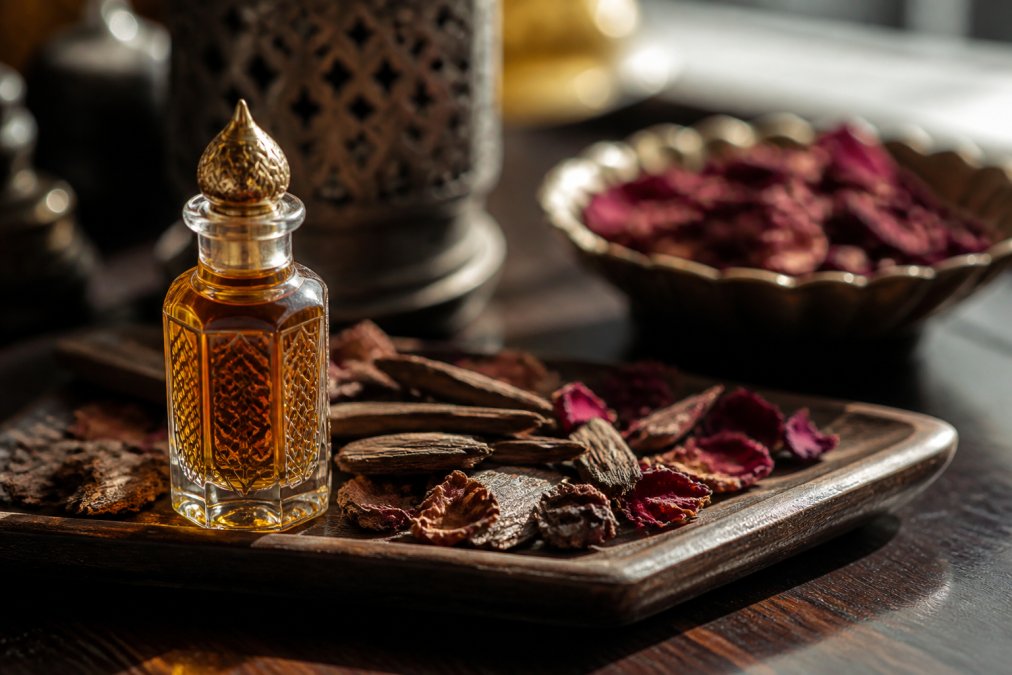
Agarwood, Resin, and the Real Source of Oud
Oud is the dark, resinous heartwood produced when Aquilaria trees respond to natural stress or infection. (peer-reviewed research) The tree produces resin as a defense, and that resin is what perfumers distill into oud oil.
Not every Aquilaria tree produces resin, only a small portion do, which is why genuine oud costs more than most fragrance materials. Much of what reaches the mass market is synthetic oud, built from woody and leathery compounds that mimic the real thing.
For beginners, this matters less than you'd think. A well-made synthetic oud can smell excellent and cost far less. The trade-off is depth: natural oud evolves on skin over hours, while synthetics stay closer to their opening.
Scent Profiles and Notes: Reading an Oud Fragrance Pyramid
A fragrance pyramid describes how a scent unfolds over time. Oud blends follow the same three-tier structure as any perfume, but the tiers behave differently because resin is heavy and slow to develop.
Top, Heart, and Base Notes in Oud Blends
- Top notes: the first 15-30 minutes. In oud blends, expect citrus, saffron, or light spice.
- Heart notes: the middle 1-3 hours. Rose, jasmine, and patchouli typically appear here.
- Base notes: hours 3 through dry down. Oud, amber, musk, and sandalwood dominate.
The dry down is where oud earns its reputation. A blend that opens sharp or medicinal often settles into something warm and woody within 30 minutes. Don't judge an oud fragrance from the first spray.
Best Oud Fragrances for Beginners
The best oud fragrances for beginners are lighter, rose-forward blends rather than pure oud oils. Pure oud can read as medicinal or barnyard-like to an untrained nose, and starting there is a common mistake.
A practical approach:
- Start with a rose-oud blend. Rose softens the resin and adds familiarity.
- Try a mukhallat, a blended Arabic composition that combines oud with florals and spice.
- Move to attar, a concentrated perfume oil, once you know you enjoy the profile.
- Sample before committing to a full bottle.
| Beginner Type | Intensity | Best For | Application |
|---|---|---|---|
| Rose-oud eau de parfum | Moderate | First-time oud wearers | 2-3 sprays |
| Mukhallat blend | Moderate to strong | Evening wear | 1-2 sprays |
| Attar perfume oil | Strong | Collectors and connoisseurs | Dab on pulse points |
| Woody amber oud | Light | Daily office wear | 2 sprays |
How to Layer Oud Perfumes Without Overpowering the Blend
Layering oud perfumes works best when you treat oud as a base and let lighter scents sit on top. Oud is dense and projects strongly, so apply it first, closest to the skin.
The sequence:
- Apply a light oud or woody base to pulse points and let it settle for two minutes.
- Add a rose, citrus, or vanilla fragrance over it.
- Keep the second layer lighter than the first.
A common mistake is layering two heavy oud blends, which creates a muddy, cloying cloud. If both fragrances contain oud, use one spray of each, maximum.
Longevity, Sillage, and Concentration Explained
Longevity is how long a fragrance remains detectable on skin. Sillage is the scent trail it leaves behind you. Projection is the radius others can smell you from while you stand still. Concentration drives all three, but resin content, carrier, skin chemistry, and climate also move the numbers.
What the Concentration Labels Actually Mean
- Eau de cologne: roughly 3-5% aromatic compounds. Light, short-lived, rarely used for oud.
- Eau de toilette (EDT): roughly 5-15%. Opens bright, fades within a few hours on most skin.
- Eau de parfum (EDP): roughly 15-20%. The most common format for oud blends sold to Western beginners.
- Extrait de parfum / parfum: roughly 20-30%. Dense, slow, and often too heavy for daytime wear.
- Attar / perfume oil (mukhallat base): undiluted or near-undiluted oil with no alcohol carrier. A single dab can outlast an EDP by several hours.
These ranges are industry conventions, not regulated thresholds. A house can label a 12% formula "eau de parfum" with no legal consequence in most markets, which is why the label alone is a weak buying signal.
Why Oud Behaves Differently From Lighter Families
Oud's dominant molecules are heavy, low-volatility sesquiterpenes and resinous compounds that evaporate slowly. That is why oud blends sit in the base of the pyramid and why a quality EDP commonly runs six to ten hours on skin, with extrait and attar often pushing past twelve, versus two to three hours for a citrus-forward EDT.
The trade-off: heavy molecules also mean a slower opening. An oud blend may smell sharp, inky, or medicinal for the first 20-30 minutes before the resin warms up. That is not a defect. It is the material doing what it does.
The Variables That Move the Numbers
- Skin type. Oily skin holds fragrance longer than dry skin. Dry skin benefits from an unscented moisturizer or a thin layer of carrier oil applied before the spray.
- Body heat. Pulse points (inner wrist, side of neck, behind the ear, inside the elbow, behind the knee) run warmer and push scent outward faster. Warm skin = stronger projection, shorter total wear. Cool skin = softer projection, longer wear.
- Humidity. In humid heat, oud projects further and can read as heavier than intended. One or two sprays is usually enough.
- Dry cold. In dry cold, the same fragrance sits closer to the skin and lasts longer without filling a room. You may need a third spray to be noticed.
- Application site. Spraying on clothing extends longevity dramatically but flattens the development, because fabric does not have the heat and oils that drive the dry down.
A Practical Calibration Routine
- Spray one application on one wrist only.
- Note the time. Check at 30 minutes, 2 hours, 4 hours, and 8 hours.
- Record what you smell at each checkpoint, opening, heart, base, or nothing.
- Repeat the next day with two sprays and compare.
Most wearers find their sweet spot within three or four trials. Stop guessing from the label and start measuring on your own skin.
Climate-Based Selection: The Angle Most Guides Skip
Oud is not climate-neutral. The same bottle can be a signature scent in one region and unwearable in another.
- Hot and humid: choose lighter rose-oud EDPs, citrus-forward openings, or a single dab of attar. Avoid heavy amber-oud extraits in daytime.
- Hot and dry: oud performs well here. EDPs hold their structure, and you can wear stronger blends without suffocating a room.
- Cold and dry: oud can go quiet. Extrait, attar, or a layered application over moisturizer restores projection.
- Cold and humid: the trickiest combination. Oud can read as flat and sour. A rose or saffron-forward blend usually holds up better than a pure resin profile.
If you buy online from a seller in a different climate zone, ask how the fragrance performs in your conditions, reviews written in a different humidity band are only partially useful.
Where to Buy Authentic Arabic Oud
Authenticity is the biggest concern for anyone buying oud online, and it should be. Counterfeit and diluted bottles circulate widely because genuine oud is one of the most expensive raw materials in perfumery, so the incentive to stretch, substitute, or fake it is enormous.
Synthetic vs. Natural Oud: What You Are Actually Buying
This is the single most useful distinction a beginner can learn.
- Natural oud oil (dehn al oud): distilled from resinous Aquilaria heartwood. Only a small fraction of Aquilaria trees ever produce resin, and trees must mature for years before harvest. The result is a material priced by the gram, not the milliliter, and it varies batch to batch the way wine does.
- Synthetic oud accords: built from aroma compounds, commonly woody, leathery, and smoky molecules, that reproduce parts of the natural profile. Consistent, affordable, and often genuinely pleasant.
- Blended oud: a natural oud base stretched with synthetics and other woods (sandalwood, cedar, guaiac) to hit a price point. This is what most mass-market "oud" fragrances actually are.
None of these is automatically bad. A well-constructed synthetic oud can smell excellent and cost a fraction of the natural material. The trade-off is behavior: natural oud evolves on skin over hours, shifting through stages, while synthetic accords stay closer to their opening and dry down more linearly.
What you should object to is being sold a synthetic blend at a natural-oud price, or a diluted bottle at full concentration.
How to Read a Listing Before You Buy
- Concentration on the label. EDP, extrait, attar, or oil, the format tells you more about performance than any marketing copy.
- Named ingredients vs. vague ones. "Oud, rose, saffron" is a real pyramid. "Oriental accord" is a marketing phrase.
- Batch or lot number. Reputable sellers list one. It lets you trace a bottle and compare notes with other buyers.
- Return policy on opened bottles. A seller confident in authenticity will usually accept returns on opened items within a stated window. A seller who refuses all opened returns is telling you something.
- Price sanity. If a listing claims natural oud oil at a price far below the rest of the market, it is almost certainly synthetic, diluted, or mislabeled. There is no bargain natural oud.
What to Ask a Seller Directly
A short, specific question separates real retailers from drop-shippers:
- Is this natural oud, synthetic, or a blend?
- What is the concentration, and in what format?
- Can you describe the opening, heart, and dry down in plain language?
- What is your policy on opened-bottle returns?
- Do you have a batch or lot number for this bottle?
A seller who answers all five in writing is worth buying from; one who dodges any of them is not.
Regulatory Context You Can Rely On
Fragrance ingredients and cosmetic labeling are governed in the United States by the U.S. Food and Drug Administration cosmetics labeling requirements, which outlines what cosmetic products must disclose on their packaging. Ingredient safety and industry standards are published by the International Fragrance Association standards. Neither body certifies that a specific bottle contains natural oud, that is a seller-level claim, which is exactly why the questions above matter.
Why Buying From an Established Retailer Reduces Risk
Perfume Outlet has served fragrance enthusiasts since 2006, offering guaranteed authentic designer and Arabic scents at outlet prices. Our team helps customers narrow down options by scent profile, occasion, and intensity, which matters when you cannot smell a bottle before it arrives. An established retailer with a written authenticity guarantee, a stated return policy, and staff who can describe a scent in plain language removes most of the risk that comes with buying oud online.
Conclusion
Finding an oud fragrance you love takes a little trial, but the payoff is a signature scent that stands apart from mainstream designer releases. Start with a rose-oud blend, learn how the pyramid develops on your skin, and layer only when you understand how the base behaves.
Perfume Outlet stocks many Arabic oud fragrances for men, women, and unisex wear, backed by guaranteed authenticity and expert guidance to match a scent to your style. Shop now and find your oud.
Frequently Asked Questions
What does Arabic oud smell like?
Oud is woody and resinous, with a warm, slightly smoky character that can read animalic or leathery depending on the blend. Most Arabic oud fragrances pair the agarwood base with rose, saffron, amber, or musk, so the opening may smell spicy or floral before the dry down settles into deep wood. Beginner-friendly versions soften the animalic edge with sweeter notes, making the scent easier to wear day to day.
What is the best oud fragrance for a beginner?
Start with a lighter eau de parfum rather than a heavy perfume oil or attar. Look for blends where oud sits alongside rose, saffron, or amber, since those notes round off the sharper resinous edges. Test on your skin rather than paper, because oud reacts to body chemistry and can smell different on everyone. Once you know which scent profile you prefer, you can move toward stronger concentrations.
How long does authentic oud fragrance last on the skin?
Oud is one of the longest-lasting base notes in perfumery. An eau de parfum built on oud typically stays on skin for six to ten hours, and perfume oils or attars can last well beyond that. Longevity also depends on concentration, your skin's moisture level, and the climate. Applying to pulse points and moisturizing first helps the scent hold longer through the day.
Is oud perfume considered unisex?
Yes, oud is traditionally unisex. In Arabic perfumery, the same agarwood base appears in men's and women's blends, with the surrounding notes deciding the character. Rose and saffron lean more feminine to some noses, while leather and smoke lean masculine, but most oud fragrances sit comfortably in the middle. Wear what matches your style rather than the label on the bottle.
How do I layer oud perfumes without the scent becoming too strong?
Apply the lighter fragrance first and let it dry for a minute before adding oud. Use one spray of the oud scent on a single pulse point, like the wrist or base of the throat, and keep the second fragrance to two or three sprays elsewhere. Oud amplifies whatever it touches, so start with less than you think you need and build up over several wears.
Where can I buy authentic Arabic oud without paying department store prices?
Buy from a retailer that guarantees authenticity and has been in business long enough to have a track record. Perfume Outlet has operated since 2006 and stocks Arabic fragrances alongside designer scents, with staff who can help you pick a first oud. Avoid marketplace listings with no return policy, since counterfeit oud is common in unverified channels.