


Why Perfume Smells Different on Your Skin
Last Updated: October 29, 2026
Quick Summary
A perfume smells different on each person because the skin changes how the scent develops and how fast it evaporates. Skin type, body heat and daily habits all shape the result, so the fragrance itself stays the same while its wearer changes it.
- Dry skin can release scent faster, while oilier skin may hold fragrance longer.
- Moisturize with an unscented lotion before spraying so the scent has a film to cling to.
- Body heat speeds evaporation, so the same perfume can seem louder on a warm afternoon.
- Test a scent on paper and on your inner forearm, then compare results over several hours.
- Give a new scent a few hours to develop before deciding it smells wrong on you.
Table of Contents
- Why the Same Perfume Smells Different on Different People
- Skin Chemistry and Perfume: What the Research Shows
- Does Dry Skin Affect Perfume Longevity?
- How Body Temperature Affects Perfume Evaporation
- Perfume Top, Middle and Base Notes Over Time
- Separating Skin Effects From Perception and Adaptation
- Testing a Fragrance on Your Skin Before You Buy
- Choosing a Scent That Works With Your Skin
- Frequently Asked Questions
Why the Same Perfume Smells Different on Different People
A perfume smells different on you than it does on a friend, and that is normal. Your skin, your body heat and your daily habits all change how a fragrance develops.
Here is the short answer: the same fragrance can smell sharper, softer, sweeter or muskier depending on the person wearing it. The fragrance does not change.
Many fragrance lovers notice this the first time they buy a bottle that smelled great in the store and then turned strange at home.
Skin Chemistry and Perfume: What the Research Shows
Skin chemistry is a term people use often, but it needs careful handling. A 1996 study published in the International Journal of Cosmetic Science found evidence that perfume ingredients can change in the underarm, probably through microbially catalyzed reactions (Insight into how skin changes perfume, International Journal of Cosmetic Science).
That finding matters. It suggests the skin's own activity can alter how a scent develops. It does not prove that skin chemistry explains every difference people notice. Treat skin chemistry as one factor among several, not a complete answer.
Watch out: Do not assume a scent is "wrong" for you the first time it smells odd. Give it a few hours to develop before you decide.
Does Dry Skin Affect Perfume Longevity?
Skin type is one of the most reliable predictors of how a fragrance will behave on you, and it is also one of the most misunderstood. Learn how to make a scent stronger on your skin with practical application methods.
Most fragrances are a blend of aroma compounds carried in alcohol, with water and fixatives in the mix. When you spray, the alcohol flashes off first and lifts the top notes into the air.
Combination skin. Most people are not purely dry or purely oily. The T-zone, neck, and chest often behave differently from the forearms, which is one reason a fragrance can smell different on your wrist than on your neck.
What skin pH actually does
Healthy skin sits at a mildly acidic pH (Bathing newborn infants). That acidity varies by body site, age, and season, and it shifts with cleansing habits.
Does that variation change how a perfume smells? Treat pH as a contributing factor, not a verdict.
Practical fixes for dry skin
If fragrance fades fast on you, the fix is usually about giving the scent something to hold onto:
- Apply an unscented, fragrance-free moisturizer to the pulse points and let it absorb fully before spraying. The lotion film gives aroma compounds a lipid layer to cling to.
- Spray onto moisturized skin rather than damp skin; water accelerates evaporation and can shorten wear.
- Target warm, well-perfused areas such as the inner wrists, the base of the throat, and behind the ears, where body heat keeps the scent releasing steadily.
- Layer with a matching body oil or a fragrance oil rather than reapplying alcohol-based spray repeatedly, which can dry the skin further over time.
- Store the bottle away from heat and direct light. A fragrance that has degraded in storage will fade fast on any skin type, which is easy to mistake for a skin problem.
How Body Temperature Affects Perfume Evaporation
Body heat can influence how fast a perfume evaporates. Warmer skin may push scent into the air faster, while cooler skin may slow evaporation.
This is why the same fragrance can seem loud on a warm afternoon and gentle in an air-conditioned office. Hot weather, exercise and a warm room all increase how quickly you notice the scent.
Perfume Top, Middle and Base Notes Over Time
Perfumes unfold in stages. Top notes are the first impression, usually lively and light. Middle notes, sometimes called heart notes, appear after the top notes fade. Base notes are the deepest and last longest.
BALKAN OIL OIL By RASASI For Oil →
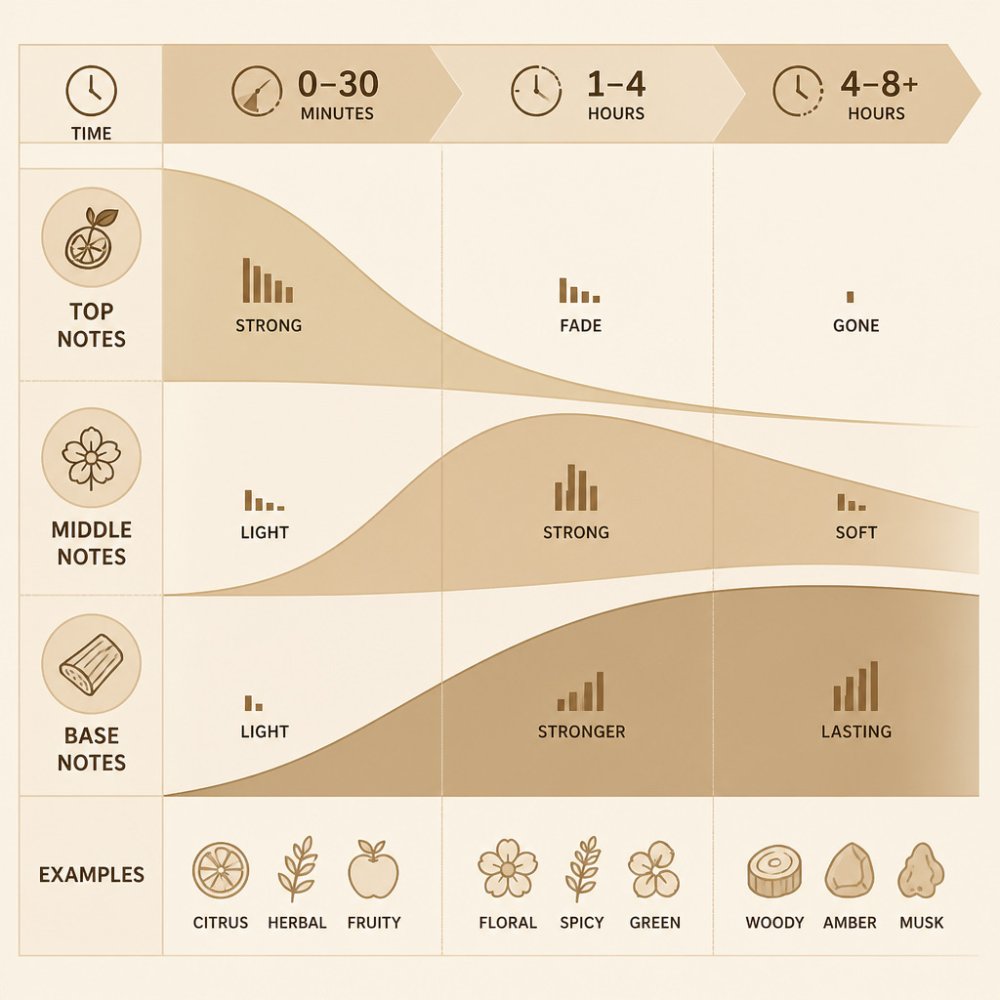
Here is a simple summary of how these stages usually behave:
| Stage | Typical Timing | What You Notice |
|---|---|---|
| Top notes | First 0-30 minutes | Bright, fresh, first impression |
| Middle notes | About 1-4 hours | Core character of the scent |
| Base notes | About 4-8+ hours | Warm, deep, lingering trail |
Timing varies by person and by fragrance, so use these ranges as a guide, not a rule.
Separating Skin Effects From Perception and Adaptation
Two other things affect how you experience a scent: perception and adaptation. Your nose gets used to a smell within minutes. After a while, you stop noticing your own perfume, even when others still smell it clearly.
This means a fragrance may seem faint to you while still being strong to people around you. It also means that a scent that smelled overwhelming at first may feel normal an hour later.
Testing a Fragrance on Your Skin Before You Buy
Most people test a fragrance wrong. See which application spots work best for beginners before you decide. They spray it on a paper strip in a store, like it, buy it, and then wonder why it smells different at home. The strip tells you what the formula smells like. Your skin tells you what the fragrance will smell like on you. Those are two different questions, and a fair test has to answer both.
The controlled comparison test
The goal is to compare blotter, skin, and wear over time while holding everything else constant. Application amount, location, and environment all change results, so control them.
- Start with a blotter. Spray one spray onto a paper tester strip, label it, and smell it immediately, then again at 15 minutes and at two hours. This is your baseline: the formula without your skin in the equation.
- Apply the same amount to skin. One spray to the inner forearm, not the wrist, which gets rubbed against sleeves and washed more often. Use the same number of sprays you used on the blotter.
- Smell at fixed intervals. Check at application, 15 minutes, one hour, three hours, and six hours. Note not just whether you like it but what changed: did the opening turn sharp, did the heart go flat, did the base arrive early or late?
- Compare blotter to skin at each interval. If the skin version is sharper, sweeter, or fades faster than the blotter, that difference is your skin's contribution. If both behave the same, skin chemistry is not the variable.
- Test one fragrance per day, maximum two. Olfactory fatigue sets in fast. After three or four scents your nose is unreliable, and coffee beans do not reset it.
- Judge the next morning. Smell the application site before washing. The residue tells you what the base notes do on your skin overnight, which is often very different from the first hour.
Troubleshooting by symptom
Once you have run a fair test, most disappointments map to a small set of causes. Use this table to diagnose what went wrong.
| What you notice | Likely cause | What to try |
|---|---|---|
| Citrus or light top notes vanish within minutes | Fast evaporation on dry skin, or a high-alcohol formula | Moisturize first; try a fragrance oil or a scent with a stronger heart |
| Opening smells harsh, sharp, or chemical | Alcohol burn on application, or pH-sensitive top notes reacting to skin | Let it settle 10 minutes before judging; test on a different body site |
| Scent goes flat or sour after an hour | Skin flora interacting with the formula, or a degraded sample | Try a fresh sample of the same scent to rule out storage; test on clothing |
| Projection is weak even when freshly applied | Low concentration, dry skin, or cool skin temperature | Apply to warmer pulse points; layer with matching lotion |
| Scent feels overwhelming or cloying | Oily skin amplifying sweet or resinous notes, or over-application | Reduce to one spray; apply to the lower body instead of the neck |
| Smells different from the store sample | Sample age, batch variation, or reformulation | Compare a fresh sample side by side; note the batch code if visible |
That last row matters more than most guides admit. Samples sit in store light and heat, and a tester that has been open for months can smell noticeably different from a fresh bottle. Batch-to-batch variation and reformulation are real, and they are a simpler explanation for a disappointing purchase than skin chemistry.
Safety and when to skip skin entirely
Not every fragrance belongs on skin. If you have sensitive skin, eczema, or a known fragrance allergy, patch test on the inner forearm and wait a full 24 hours before wider wear. Apply fragrance to clothing instead of skin when you have an active rash, a fresh sunburn, or broken skin, and remember that some fabrics, especially silk and light-colored synthetics, can stain. Spray clothing from a distance and let it dry before dressing.
Choosing a Scent That Works With Your Skin
Once you understand the factors, choosing a scent gets easier. Match the fragrance to your skin type, your climate and the occasion:
- Dry skin: Try richer scents with strong base notes, and moisturize first.
- Oily skin: Scents often last longer, so lighter options may feel strong.
- Hot climates: Choose lighter, fresher fragrances that do not fade too fast.
- Cool weather: Warmer, heavier scents often feel right.
For example, Khulasat Al Oud, a unisex oriental oud fragrance with saffron, amber and sandalwood, is listed for fall and winter evening wear. Farasha Oil, a floral fruity scent with bergamot and rose, is listed for evening and casual wear in fall and winter.
Frequently Asked Questions
Why does the same perfume smell different on different people?
Individual skin chemistry, skin moisture and body heat all influence how fragrance molecules evaporate and interact with the skin. Some research suggests that skin can change how perfume ingredients behave. That does not fully explain every difference people perceive. Diet, hormones, weather and personal scent adaptation also play a part, so testing a fragrance on your own skin remains the most reliable way to judge it.
Does dry skin affect how long perfume lasts?
Dry skin may hold fragrance less well than moisturized skin, so scents can fade faster for some people. Applying perfume to lightly moisturized skin gives the molecules a surface to cling to. Unscented moisturizer is a practical way to extend wear time. Oily skin often holds fragrance longer, though results vary by person and by formula.
How does body temperature change the way perfume smells?
Warmer skin may speed evaporation, which can make top notes feel stronger early on. Cooler conditions may slow evaporation, so the scent may feel softer. Pulse points such as the wrists and neck tend to be warmer, which is one reason fragrance can smell stronger there.
What are top, middle and base notes in perfume?
Top notes are usually the lightest and evaporate first. Middle or heart notes emerge as the top notes fade. Base notes are typically the heaviest and linger longest. Judging a perfume only by its first spray can give a misleading impression.
We at Perfume Outlet have spent years helping fragrance lovers find scents that suit their skin and style. Browse our full range of branded and Arabic fragrances, read our product notes and find a scent that fits your body and your season.
