


Best Perfume Concentrations for Hot Weather: 2026 Guide
Table of Contents
- Why Heat Changes How Your Perfume Performs
- Perfume Concentration Guide: What the Labels Actually Mean
- EDT vs EDP for Summer: Which One Wins in the Heat?
- Best Fragrance Notes for Hot Weather
- How to Make Perfume Last in Summer: Application and Reapplication
- 7 Summer-Ready Picks by Concentration
- Matching Concentration to Your Climate and Skin
- Conclusion
- Frequently Asked Questions
Last Updated: October 17, 2026
Why Heat Changes How Your Perfume Performs
Heat makes fragrance molecules evaporate faster, which is why a scent that lasts all day in January can vanish by noon in July. Warm skin radiates fragrance more aggressively, so projection climbs while wear time drops. At Perfume Outlet, we have spent years helping customers pick bottles that hold up in warm weather, and the pattern is consistent: concentration matters, but so does the formula around it.
Perfume concentrations describe the ratio of fragrance oil to alcohol and water in a finished bottle. Higher oil content generally means slower evaporation and longer wear, but heat rewrites the math. A rich extrait can turn heavy and cloying in high humidity, while a lighter eau de toilette may fade before lunch.
The takeaway: pick concentration for the climate you are actually wearing it in, not the one on the label's marketing copy.
Perfume Concentration Guide: What the Labels Actually Mean
Perfume concentrations fall into four common tiers, but the first thing to understand is that these labels are not standardized. There is no single industry body that enforces what percentage of fragrance oil makes a bottle an eau de toilette versus an eau de parfum. Each house sets its own ranges, and two bottles with the same label from different brands can perform very differently.
| Label | Typical Oil Range | Behavior in Heat |
|---|---|---|
| Eau de Cologne | Roughly 2-5% | Fades fast, stays crisp and clean |
| Eau de Toilette | Roughly 5-15% | Fresh, needs reapplication by afternoon |
| Eau de Parfum | Roughly 15-20% | Can bloom heavily on warm skin |
| Parfum / Extrait | Roughly 20-30% | Rich, best applied sparingly in heat |
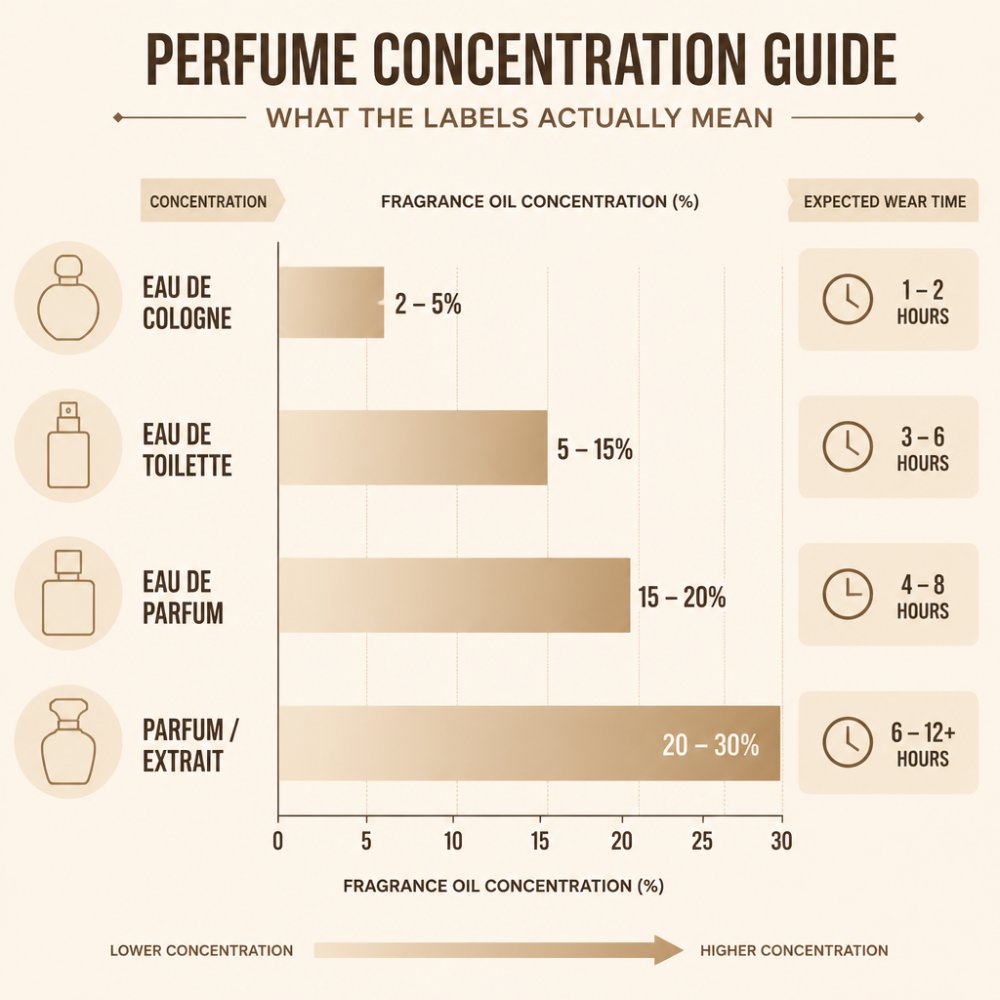
Treat those percentages as a guide, not a guarantee. Sources disagree on the exact cutoffs, some houses push an eau de toilette toward the top of its range, and a few release extraits well above 30%. The Fragrance Foundation's guide to fragrance families and strengths is a useful reference for how these tiers are described industry-wide, but even that is descriptive rather than regulatory.
What most guides miss is that the oil percentage is only half the story. The other half is the note structure inside that oil. A 20% eau de parfum built on citrus and light musk can feel airier and fade faster than a 10% eau de toilette loaded with amber, oud, and resin.
A practical way to read a label: use the concentration tier as a starting expectation for strength, then read the base notes to judge how it will behave in heat. If the base is dominated by amber, oud, or vanilla, expect it to bloom even at eau de toilette strength. If the base is vetiver, light musk, or transparent woods, even an eau de parfum can wear cleanly on a warm afternoon.
EDT vs EDP for Summer: Which One Wins in the Heat?
Eau de Toilette usually wins for daytime summer wear, while Eau de Parfum works better for evenings or air-conditioned settings. The reason is simple: EDT's lighter oil load evaporates more cleanly in heat, staying crisp instead of turning syrupy. EDP's higher concentration can project too strongly when skin temperature rises, especially in humidity.
That said, EDT is not automatically better. A poorly built EDT with heavy base notes can still feel thick in August, and a well-composed EDP with citrus and marine notes can wear beautifully on a warm evening. Concentration sets the ceiling; formula decides the experience.
Best Fragrance Notes for Hot Weather
Fresh, light profiles outperform heavy ones in heat, and the note families below are the most reliable choices. Citrus notes like bergamot and lemon read clean and sharp. Aquatic and marine notes feel cooling. Green notes such as galbanum add a crisp edge. Floral notes work when they are airy, like freesia or orange blossom, rather than dense.
The notes to approach with caution in high heat are the heavy base notes: oud, amber, and vanilla. These are not off-limits, but a little goes a long way when skin temperature is elevated. Transparent woods, vetiver, and light musk make better summer anchors because they support the fresh top without weighing it down.
A balanced fragrance for warm weather keeps its base quiet and lets citrus, green, and marine notes carry the opening. When you are shopping, read the base notes first. If the base is dominated by amber and oud, expect it to bloom in the heat.
How to Make Perfume Last in Summer: Application and Reapplication
Longer wear in summer comes from preparation, placement, and a realistic testing routine, not from spraying more. Follow this sequence:
- Apply to moisturized skin; dry skin releases fragrance faster, so a light unscented lotion before spraying helps
- Target pulse points and the back of the neck, not just the wrists
- Spray from 15-20 cm away for even coverage
- Avoid rubbing wrists together; it crushes the top notes and speeds the fade
- Carry a travel spray for a midday refresh
- Store bottles away from direct sunlight and heat, which degrade the formula over time
Reapplication is normal in summer, not a sign of a weak fragrance. A light eau de toilette may need a second pass after three to five hours, while an eau de parfum often holds through a workday. Keep the second application smaller than the first so the scent stays subtle rather than overpowering, and reapply to clothing or a scarf when you can, since fabric releases fragrance more slowly than warm skin.
LIGHT BLUE 1.69 OZ (50ml) Eau De Toilette Spray By DOLCE AND GABBANA →
Test before you commit. The only reliable way to know how a concentration performs in your weather is a wear test. Spray once on your inner forearm in the morning, note the time, and check in every couple of hours without topping up. Do this on a humid day and again on a dry day if you can, because the same bottle can behave differently in each. A simple pattern many people find: citrus-heavy scents fade fastest, green and aquatic notes sit in the middle, and woody or musky bases outlast both. Use those observations to decide whether you need an eau de parfum for a given setting or whether an eau de toilette plus one refresh is enough.
Application safety in sun and heat. Spraying fragrance directly onto skin that will be in strong sun is a common mistake. Citrus-heavy formulas can cause photosensitivity reactions on exposed skin, so apply to covered areas, clothing, or hair when you will be outdoors for long stretches. Avoid freshly shaved or irritated skin, and if you are sensitive to strong scents, apply to fabric rather than skin and keep the dose small in shared spaces like offices and cars.
7 Summer-Ready Picks by Concentration
Here are seven bottles from our shelves that suit warm weather, grouped by concentration so you can match strength to setting. Every pick below is a genuine designer or niche release, and our team can help you narrow the list if you are shopping in person or online.
- Light Blue by Dolce & Gabbana (EDT, $69.00) - A woody aromatic citrus built for hot weather wear, with Sicilian mandarin and grapefruit over musk and oakmoss.
- CK One by Calvin Klein (EDT, $39.00) - A unisex citrus aromatic that stays soft and clean in heat, ideal for daytime casual wear.
- Yellow Diamond by Versace (EDT, $90.00) - A floral fruity with lemon, pear, and freesia that reads bright rather than heavy.
- Light Blue Summer Vibes by Dolce & Gabbana (EDT, $60.00) - A floral woody musk with peach and green apple for casual summer days.
- Versace Pour Homme (EDT, $74.00) - An aromatic fougere with lemon and neroli that suits office and daytime wear.
- 9AM Dive by Afnan (EDP, $44.00) - An aromatic aquatic with mint and black currant; the EDP concentration gives it more staying power for evenings.
- Rayhaan Aquatica (Extrait de Parfum, $54.00) - A fresh woody marine extrait with sea notes and driftwood, best applied sparingly in heat.
Matching Concentration to Your Climate and Skin
Dry heat and humid heat call for different choices, and your own skin chemistry decides the rest. In dry heat, fragrance evaporates quickly and skin feels thirsty, so a slightly higher concentration like EDP holds up better. In humid heat, scent lingers closer to the skin and can turn heavy, which is where lighter EDTs and colognes shine.

Skin type matters too. Oilier skin tends to hold fragrance longer; drier skin releases it faster. If you know your skin runs dry, moisturize before applying and lean toward EDP. If your skin is oilier, an EDT will often carry you through the day without reapplication.
The practical rule: match concentration to humidity and skin, then match notes to the season. Concentration sets how long a scent lasts; formula and note composition decide whether it smells right in the heat.
Conclusion
Choosing the right perfume concentration for hot weather comes down to matching oil strength to your climate, your skin, and the time of day you plan to wear it. Lighter EDTs handle humid afternoons, EDPs and extraits suit dry heat and evenings, and fresh citrus, green, and marine notes keep everything crisp.
At Perfume Outlet, we have been helping fragrance shoppers since 2006 find authentic designer and niche scents at outlet prices. Our team offers expert guidance for personalized scent selection, a huge selection of men's and women's fragrances, and guaranteed authenticity in every bottle. If you are building a summer rotation, start with one fresh EDT and one EDP for evenings.
Frequently Asked Questions
Is eau de toilette or eau de parfum better in hot weather?
For most people, eau de toilette is the safer choice in heat. Its lower fragrance oil concentration keeps projection closer to the skin, so the scent stays crisp instead of turning heavy or cloying. Eau de parfum can still work if the formula leans fresh, like an aquatic or citrus-forward blend, but heavier EDPs with amber, vanilla, or oud bases tend to feel overpowering above 85°F. If you love an EDP, apply less and target pulse points rather than clothing.
What fragrance notes work best in hot, humid weather?
Citrus, green, marine, and light floral notes hold up best when humidity is high. Bergamot, lemon, grapefruit, and mandarin give a clean opening, while sea salt and aquatic accords keep the scent airy. Vetiver and transparent woods add structure without weight. Skip dense base notes like oud, heavy amber, and vanilla during the day; they amplify in heat and can read as suffocating. Save those for evening wear when temperatures drop.
How do I make perfume last longer in summer?
Apply to moisturized skin, since dry skin releases fragrance faster. Target pulse points like wrists, inner elbows, and the base of the throat, and avoid rubbing your wrists together because it breaks down the top notes. A light, unscented lotion underneath helps anchor the scent. Carry a travel spray for a midday refresh rather than over-applying in the morning. Storing your bottle away from heat and sunlight also protects the formula over time.
Does perfume project more in hot weather?
Yes, heat increases evaporation, so fragrance rises off the skin faster and projects more in the first hour. The trade-off is longevity: the same heat that boosts the opening also burns through top notes quickly. That is why a lighter concentration often outperforms a heavy one in summer. You get a bright, noticeable opening without the scent turning stale or overwhelming by mid-afternoon.
Ready to find your warm-weather signature? Shop our summer-ready picks at Perfume Outlet and let our team help you choose a concentration that works with the heat, not against it.